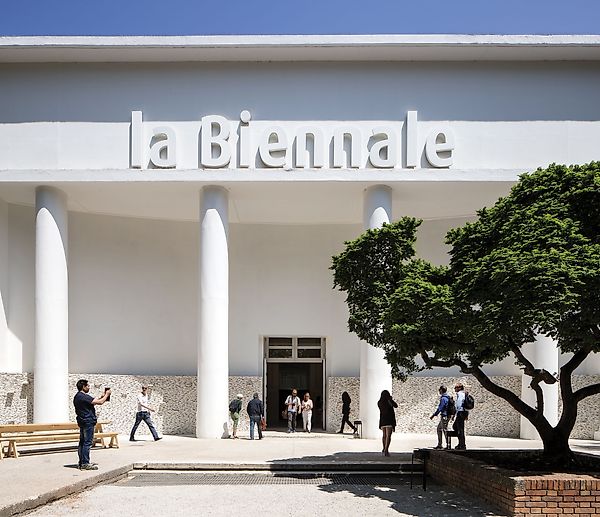
Last week, the Venice Biennale announced that Iran had dropped out of the exhibition. Now, it appears, that report was incorrect. On Tuesday, Aydin Mahdizadeh Tehrani, the director-general of visual arts at the Iranian ministry of culture and Islamic guidance told the Iran Students News Agency that it still plans to participate. “Iran never withdrew from participating in the Venice Biennale,” Tehrani said, as translated by Google Translate. “Incidentally, we had the initial agreement to participate in Venice and we are still in consultation. We have submitted a plan to participate in the Biennale as an exhibition, and we will probably receive a receive a response in the next few days.” Related Articles Across Venice, Artists Defy Censorship to Mourn and Memorialize Gaza Venice Diary Day 3: Offsite Highlights Include Fleshy Films and Vegetarian Videos In an extensive Q&A with ISNA, Tehrani said he was confused by the Biennale organizers’ statement after it never gave them a letter of withdrawal, nor announced that they weren’t participating. He said further that Iran’s organizers were in conversations with the Biennale to resolve several issues related to sanctions against Iran, high financial costs of renting a space for the pavilion, the lack of permanent Iranian cultural infrastructure in Italy, and the ongoing war with Israel and the US. While those issues are still in the process of being resolved, the ministry has continued to work on the pavilion. He said further that the ministry sent a a letter to the Biennale on May 10 stating that it “insists” the Iranian Pavilion be opened even if competing for Golden Lions is no longer possible. The country still plans to mount “a completely new and different project … based on new technology and approaches” in its pavilion, according to Tehrani. “We are now waiting for the final answer, and I think we will finally receive a definitive answer within the next day or two,” Tehrani said. “Our mindset and plan is to definitely be in Venice this summer.” Tehrani suggested that proposed exhibition may travel after its time in Venice to other European cities. While Tehrani was somewhat cagey on what form exactly the proposed Iranian Pavilion, the entire interview is worth the read for a close look at how he views arts within Iran. Meawhile, a group purporting to represent the Iran Pavilion announced last week the Hyperstitional Pavilion of Iran, with the exhibition, “Hulul: On Incarnation and Incantation,” which said it was being staged on behalf of Iranian artists and curators at risk. Curated by Pouya Jafari and Nazli Jan Parvar, the pavilion features work by Iranian artists Real Iran, Dast Dastan, Zendan-e Eskandar, Mogh Kouh, and Dorna. The pavilion is being facilitated by Perpetuum Mobile, a Finland-based arts nonprofit, and, according to a press release, is located in the Giardini. “Hulul proposes a different mode of presence: not as a representation of a state, but as a continuous process of becoming,” the press release reads. “Hulul: On Incarnation and Incantation offers neither a unified image nor a singular narrative. Instead, it proposes a space in which Iran’s multiplicities, historical, imagined and dispersed, coexist and recombine. What emerges is a porous and dynamic condition: a pavilion that does not stand in Venice, but resonates through it, carrying with it the voices of an ancient yet civilization in becoming.” “Hulul” remains unlisted on the Biennale’s official website, and it seems unclear what, if any, connection there is officially to the state of Iran.