Gallerist Bruno Bischofberger, Who Catalyzed Basquiat/Warhol Collaboration, Dies at 86
80May 12, 2026
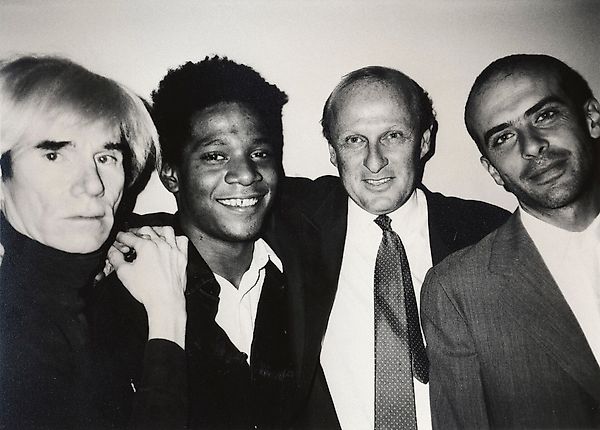
Swiss art dealerBruno Bischofberger, who fostered the famous collaboration between Andy Warhol and Jean-Michel Basquiat, died on May 9. He was eighty-six. His death was announced on May 9 by his namesake gallery, which he had operated since 1963. Bischofberger played a crucial role in introducing US Pop artists to Europe and forged close, enduring relationships with many of those he represented. Among these were Warhol and Basquiat, whose collaboration resulted in Warhol’s return to painting twenty years after he abandoned the practice. Bischofberger’s talent as a gallerist also had an artistic component, one that reached viewers all over the world: His fancifully idiosyncratic ads gracedArtforum’s back cover for nearly four decades.
Bruno Bischofbergerwas born in Appenzell, Switzerland, on January 1, 1940. Having obtained his Ph.D. in Swiss folk art from the University of Zurich, he opened Galerie Bruno Bischofberger, then called City-Galerie, on Zurich’s Pelikanstrassein 1963 (the gallery would move three times before arriving at its current location, in Männedorf, Zurich). Two years later, at the age of twenty-five, he mounted “Pop Art,” an exhibition of the form then hotly ascendant in New York and featuring work by Roy Lichtenstein, Claes Oldenburg, Robert Rauschenberg, James Rosenquist, Andy Warhol, and Tom Wesselmann.
The following year, Bischofberger visited New York and met Warhol in person. In 1968, he convinced the artist to part with eleven paintings, including Superman, Batman, a Coca-Cola, and several works from the 1962–65 “Death and Disaster” series. Though Bischofberger was convinced he had paid too high a price, the deal cemented a personal and professional bond between the pair that would lead Warhol to offer the gallerist first right of refusal of his artwork. The arrangement endured until Warhol’s death in 1987, and would see Bischofberger introduce his work to megacollectors including American publishing baron Peter Brant and Greek shipping heir Philippe Niarchos.
Accompanied by various members of the artist’s entourage, Bischofberger and Warhol frequently traveled around Europe together throughout the 1970s and ’80s. Beginning in the late ’70s, Bischofberger started adding important European artists to his roster, among them Francesco Clemente, Enzo Cucchi, Gerhard Richter, and Jean Tinguely, whose work he showed alongside that of rising American firebrands George Condo, Julian Schnabel, David Salle, and Basquiat. In 1982, on learning that Basquiat had parted ways with gallerist Annina Nosei, Bischofberger offered to represent him, which he did until the artist’s untimely death in 1988. The gallerist commissioned Clemente, Basquiat and Warhol to create a series of collaborative works for a 1984 exhibition, sparking further collaboration between the two American artists, with Basquiat managing to convince Warhol to retake up painting, a mode he had shied from some two decades earlier in favor of movies.
In the mid-1980s, Bischofberger was offered a coveted advertising spot on the back cover of Artforum. He seized the opportunity to bring attention to his already starry stable of artists, and never relinquished it. Over the ensuing decades, the space was occupied by a steady stream of quirkily charming ads that were consistent in template—the gallery’s name and address, and the last names of its artists, in a plain sans-serif font, atop a single full-bleed photograph—and diversely fascinating in their subject matter, which drew heavily on Bischofberger’s deep and abiding knowledge of Swiss folkloric art and love of his native country. Among the scenes depicted were various festivals and ceremonies, the judging of longhorns, the making of cheese, and the view of a looming snowcapped mountain peak from the window of a helicopter. The back cover of Artforum’s April issue depicts two men, one wearing a suit made out of playing cards, wrestling in a street filled with festive detritus under the watchful gaze of a beast-masked figure who appears to be clad entirely in pebbles.
Among Bischofberger’s other enterprises were publishing—in 1969, he took a 25 percent stake in Interview magazine, which Warhol cofounded earlier that year—and producing, namely Warhol’s 1970 film L’amour. He remained an enthusiastic collector of Swiss folk art and modernist furniture until the end of his life. “My father is a hoarder,” his daughter Nina Baier-Bischofberger told W magazine in 2015. “He always wants more, more, more.”)
In addition to Baier-Bischofberger, Bischofberger is survived by his wife, Christine; daughters Lea and Cora; son Magnus; and ten grandchildren. His influence has continued to ripple throughout the decades: Dennis Hopper played the gallerist in Schnabel’s 1996 film Basquiat. Warhol and Basquiat’s collaborative paintings, many of them worth millions, in 2023 were the subject of a major exhibition at the Fondation Louis Vuitton in Paris.