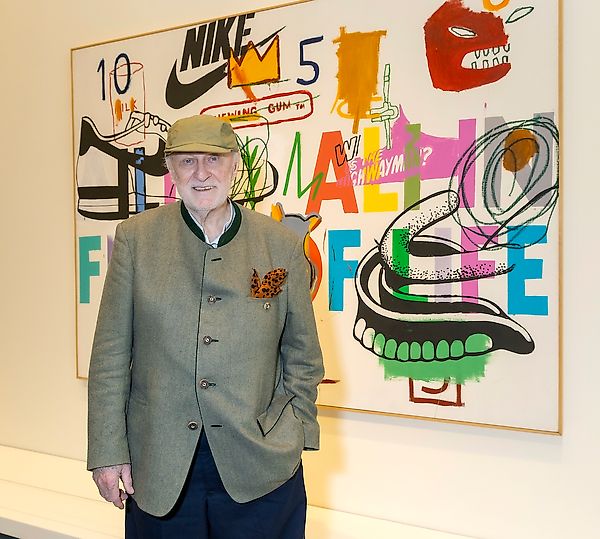
Bruno Bischofberger, a legendary dealer who grew so close to the artists he loved that he became something like a collaborator to them, shaping art history along the way, has died at 86. His Zurich-based gallery announced his death on Saturday. Through his eponymous gallery, Bischofberger helped bring a range of American art stars to Europe, becoming a significant force in the market along the way. Founded in 1963, that gallery is still considered one of the most important ones in Switzerland, a country rich with blue-chip art spaces, and remains a mainstay not only in the international art world but also the international art press. Related Articles Timm Ulrichs, Pioneering Conceptual Artist, is Dead at 86 James Hayward, West Coast Painter with a Cult Following, Dies at 82 Among other things, the gallery is known for taking out an advertisement on the back page of every issue of Artforum, a tradition it has continued since the mid-’80s. “Bischofberger’s aesthetic is characteristically Swiss in its incredible consistency,” Artnet News was moved to note in 2015, the year that Galerie Bruno Bischofberger left its St. Moritz space and revealed plans to open a complex in Zurich. Beyond the Artforum ads, Bischofberger also made a significant contribution to the trajectory of contemporary art, personally befriending artists such as Francesco Clemente, Julian Schnabel, and Andy Warhol and even transforming their practices along the way. His ties with Warhol proved most fruitful. “I have been involved with Andy Warhol for a large part of my life as an art dealer, collector and friend,” Bischofberger wrote in 2001. Bischofberger and Warhol first met in New York in 1966, a year after the dealer included the Pop artist’s work in a group show at the gallery. Then in 1968, Bischofberger proposed to buy some of Warhol’s early paintings; the Pop artist trotted out 20 works, and Bischofberger took 11 of them for what the dealer described as “a very high price.” But the price was worth it for Bischofberger, who persuaded Warhol to give him right of first refusal for his art, a stipulation that the artist upheld until his death in 1987. Yet Bischofberger’s working relationship with Warhol exceeded the art market. In 1969, Bischbofberger acquired a 25 percent stake in Interview, the magazine that Warhol cofounded that year, and in 1970, Bischofberger served as a producer on L’amour, Warhol’s feature film about disillusioned hippies in Paris. Bischofberger is credited with conceiving the idea for Warhol to do portrait commissions of people in his circle. In 1984, the dealer even proposed for Warhol and Jean-Michel Basquiat to work together on a famous series of collaborative paintings, having already linked up the artists two years prior. Those paintings made with Basquiat brought Warhol back to painting, a medium he claimed to have abandoned in the early ’60s. The artists’ collaboration formed the basis of an entire exhibition at the Fondation Louis Vuitton in Paris in 2023, and the works that came out of Warhol and Basquiat’s project are today considered highly valuable. One sold at auction in 2024 for $19.4 million. Bischofberger became so intertwined with Warhol that at least one work by the artist was co-authored with the dealer’s kin. In 1982, for example, Warhol painted a small work for Bischofberger’s daughter, Cora. The painting includes an elephant that was personally scrawled by Cora, then three years old, who would go on to contribute elements to works by Basquiat and Clemente. Bruno Bischofberger was born in 1940 in Zurich. According to a biography on his gallery’s site, he began to read about art history as a teenager, and he went on to study in that field, ethnography, and archaeology at the University of Zurich, where he would also develop an interest in folk art. He married his wife Christine (known familiarly as Yoyo) in 1971, and they would go on to live in a house designed by Ettore Sottsass that is located outside Zurich. Together, they had three daughters and one son, all of whom became integrated into the art world through Bischofberger’s work. Warhol became the godfather of their son, Magnus, and the sculptor Jean Tinguely became the godfather one of their daughters, Nina, who is now an architect. Following its founding in 1963, the gallery embarked on an adventurous run that included exhibitions for artists such as Warhol, Tinguley, Gerhard Richter, Sol LeWitt, Donald Judd, Anthony Caro, and Bruce Nauman during its first decade. (As was common for commercial spaces at the time, the gallery’s programming was almost exclusively for male artists.) Then, during the ’80s, the gallery would mount shows for painters such as Basquiat, Clemente, Schnabel, George Condo, David Salle, Kenny Scharf, and Enzo Cucchi. For a period, Galerie Bruno Bischofberger became Basquiat’s main representative during the artist’s lifetime. The dealer was even played by Dennis Hopper in Basquiat, Schnabel’s 1996 film about the titular artist, who died at age 27 in 1988. Across the years, Bischofberger amassed a vast collection of design objects by artists ranging from Le Corbusier to Jean Prouvé. To remedy the problem of storing and displaying it all, he began buying portions of a former factory in Zurich; according to W, by 2005, he owned all 250,000 square feet of its campus. He brought on Baier Bischofberger Architects, a firm run by his daughter Nina Baier-Bischofberger and her husband Florian Baier, to redesign the space, which also included a gallery. In 2015, the complex was inaugurated with a Miquel Barceló show. “My father is a hoarder,” Baier-Bischofberger told W at the time. “He always wants more, more, more.”