Georg Baselitz, Lion of German Neo-Expressionism, Dead at 88
107May 1, 2026
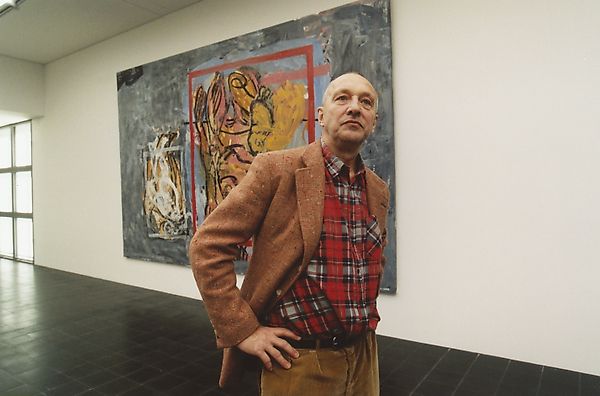
Painter, printmaker, and sculptorGeorg Baselitz, whose bold, emotional works addressed the trauma of German history, died on April 30. He was eighty-eight. His death was announced by the Thaddaeus Ropac gallery, his longtime representative. Profoundly influenced by his childhood experience of war, Baselitz was a key figure of the European Neo-Expressionist movement of the 1970s and one of the most influential artists of the twentieth century. Drawing on such disparate influences as Soviet illustration, Mannerism, and African sculpture, he created a sprawling oeuvre characterized by fierce brushstrokes and brutally hewn forms that pushed against the chilly Conceptualism and Minimalism that were ascendant during his early career. Often depicting human figures—violated or engaged in grotesque actions, and turned upside-down—Baselitz’s work evokes violence, grief, rage, and helplessness, tinged with the dark humor of the survivor and, as he would tellThe Guardianin 2015 referencing Germany’s postwar status, of “the loser.”
“I was born into a destroyed order, a destroyed landscape, a destroyed people, a destroyed society,” he toldArtforum’s Donald Kuspit in 1996. “And I didn’t want to reestablish an order: I had seen enough of so-called order. I was forced to question everything, to be ‘naive,’ to start again.”
Georg Baselitz was born Hans-Georg Kern on January 23, 1938, in Deutschbaselitz, Saxony (later East Germany). His father was a schoolteacher and a member of the Nazi Party; Baselitz, who was seven at the cessation of World War II, would later recall the smoke rising from firebombed Dresden as his mother hurried her children through the city in a futile attempt to escape the Russians.
Interested from a young age in realism and in the work of philosopher Jakob Böhme, who held that God at once embodied light and dark, good and evil, Baselitz attended the College of Fine and Applied Arts in East Berlin but was expelled, he recalled in an interview, for “socio-political immaturity” (over vacation, his peers went on a school trip to Rostock to do industrial work, while he stayed behind to paint). He moved to West Berlin and enrolled in the Hochschule der Künste, where he took the name Baselitz in honor of his hometown.
Graduating in 1962, Baselitz received his first solo exhibition the following year. Police stormed the gallery and seized two canvases—The Naked Man, depicting a nude youth gripping a monstrous phallus, and The Big Night Down the Drain, showing a Hitler-like figure masturbating. Baselitz was charged with offending public morality; the case dragged on for two years before being dismissed, but his reputation was cemented.
In 1965, following a stint in Florence, Baselitz began his “Heroes” series. Depicting shattered, demoralized figures amid bleak, thickly impastoed landscapes, the paintings commented on the psychic and physical strain of life in postwar Germany. His drawings of this period, composed of fine, tangled lines, evoked a similar tone. Shortly thereafter, he produced his “Fracture” series, forested landscapes occupied by multiply severed animal and human forms representing the conflict-ravaged nation’s divided nature.
In 1969, taking as a model Louis-Ferdinand von Rayski’s ca. 1859 Wermsdorf Woods, a work he had encountered as a schoolboy, he painted an upside-down forest in The Wood on Its Head. This strategy of inversion—which he achieved directly, rather than by flipping a finished work—represented to him a emptying-out of narrative meaning. “I begin with an idea, but as I work, the picture takes over,” he said of his process. “Then there is the struggle between the idea I preconceived and the picture that fights for its own life.”
Throughout the 1970s, Baselitz produced numerous upside-down landscapes and portraits, delving into fingerpainting around the middle of the decade and branching out into linocuts a few years later. In the 1980s, he took on sculpture, carving large, blocky forms from logs using a chainsaw, ax, or chisel. He exhibited his first major work of this nature, Model for a Sculpture, in 1980, at the Venice Biennale, alongside work by fellow countryman Anselm Kiefer. Comprising a crudely hewn wooden figure that appeared to be delivering a Nazi salute, Baselitz’s sculpture caused an uproar despite the artist’s claims that the gesture was one of surrender. The end result, as with the confiscated works of the 1963 show, was a tremendous amount of publicity and marked the beginning of Baselitz’s ascent to global recognition.
Baselitz continued to court controversy throughout his life. A fan of both Tracey Emin and Cecily Brown, he nevertheless in a 2013 Der Spiegel interview averred that women artists “don’t pass the test.” He doubled down on this assertion repeatedly, in 2015 telling The Guardian, “It’s nothing to do with education, or chances, or male gallery owners. It’s to do with something else and it’s not my job to answer why it’s so.”
In his later years, Baselitz’s work took on a more fragile tone, often featuring the aging bodies of himself and his wife of more than sixty years, Johanna Elke Kretzschmar. In the 2022 work The Painter in His Bed, the artist depicts himself, perhaps wistfully, transformed into a stag.
Baselitz was the subject of major retrospectives at the Solomon R. Guggenheim Museum in New York in 1995 and at London’s Royal Academy of Arts in 2007. In 2021 he received his largest retrospective to date, at the Centre Pompidou in Paris.
“This idea of ‘looking toward the future’ is nonsense,” said Baselitz. “I realized that simply going backwards is better. You stand in the rear of the train—looking at the tracks flying back below—or you stand at the stern of a boat and look back—looking back at what’s gone.”
He is survived by his wife and by his sons, Daniel Blau and Anton Kern.