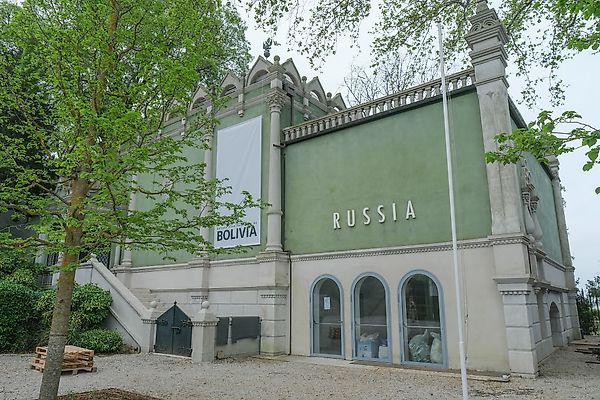
In its most forceful condemnation yet of the world’s greatest art exhibition, the European Union said it planned to cut funding to the Venice Biennale, which will host this year host Russia’s first pavilion since the nation’s invasion of Ukraine in 2022. The pavilion has faced a bitter, negative response from European leaders and artists alike. Even participants in the main exhibition have called for the exclusion of Russia, with dozens of artists in that portion of the Biennale signing an open letter that demands that the show kick out that nation, Israel, and the US, all of which are labeled “current regimes committing war crimes.” Related Articles Barbara Chase-Riboud Says She Declined US Pavilion Offer Because It Was 'Not the Moment' Alma Allen's US Pavilion Heads to Venice Amid Questions Over Selection Process The Biennale has maintained that it cannot do so, since any state recognized as a nation in Italy is allowed to participate. Among those who have called for change at the Venice Biennale is the EU, which reportedly contributes €2 million to each edition of the exhibition. While EU leaders have previously issued threatened to pull that grant in the form of strongly worded speeches, the union turned up the heat on Tuesday. “While Russia bombs museums, destroys churches and seeks to erase Ukrainian culture, it should not be allowed to exhibit its own,” EU foreign policy chief Kaja Kallas said this week. “Russia’s return to the Venice Biennale is morally wrong, and the EU intends to cut its funding.” According to Politico, which first reported news of the remark, Kallas said this during a press conference in which she also discussed further support for Ukraine. Ukraine, for its part, is also participating in the Biennale this year, as it typically does. The nation has also sought the ejection of Russia from the exhibition; it has additionally sanctioned five individuals associated with the pavilion. This week, Ukraine said it planned to take further action against the pavilion. “We have imposed sanctions on those individuals, the Russian participants,” said Ukrainian foreign minister Andrii Sybiha. “And we are now raising the issue to ensure they are not granted visas. We very much hope that we will be heard… and expect that visas will not be issued.” Yet even if Russia does end up mounting its pavilion, Ukraine’s representative, artist Zhanna Khadyrova, said she would not mount a protest. “We will focus on our message and spend all our stress to make our pavilion as good as possible,” she told Radio Free Europe this week, adding, “This is our fight.” Amid the ongoing controversy over Russia’s pavilion, at least two nations said they planned to scale back their presence at the Biennale. Last week, certain high-ranking Finnish politicians announced that they would not come to the Biennale’s opening if the exhibition moves forward with the Russian Pavilion. This week, Latvia said it would undertake a similar measure, with the nation’s foreign minister telling Politico that the Biennale granted “legitimacy through a major European cultural platform supported by European funding” to Russia, a state that faces sanctions in most corners of the continent. The Biennale has claimed it has not violated any sanctions by welcoming Russia to the 2026 edition.