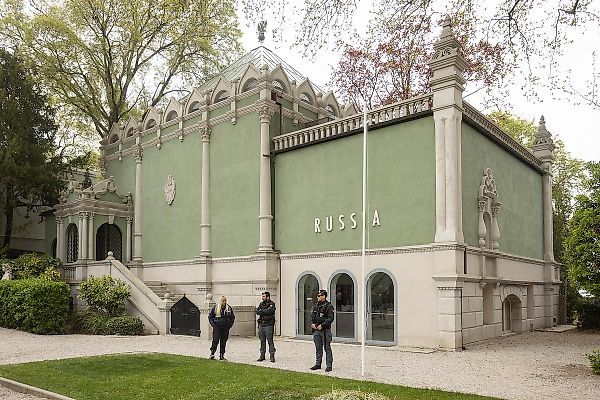
The Venice Biennale always brings with it a flurry of controversies, many of them centered on the national pavilions. For that reason, most observers and attendees expect there to be some degree of scandal built into each each edition of the world’s greatest art festival. But this year’s Biennale, opening in May, has already proven more controversial than most. Artists have repeatedly protested Israel’s presence, continuing calls for the nation’s removal that began in 2024, and the United States’s pavilion has weathered quite a bit of criticism as well. Related Articles EU Says It 'Intends' to Cut Funding to Venice Biennale Because of Russian Pavilion Barbara Chase-Riboud Says She Declined US Pavilion Offer Because It Was 'Not the Moment' But no pavilion has received quite as much scrutiny as Russia’s, which has been called out not just by artists and curators but international politicians, too. Even the EU itself has weighed in. Here’s what you need to know about the pavilion and the outcry surrounding it. What is Russia’s pavilion this year? Titled “The tree is rooted in the sky,” this year’s pavilion features more than 50 musicians, poets, and philosophers who propose that “politics exist within temporary dimensions, whereas cultures communicate in eternity,” as former culture minister Mikhail Shvydkoy told ARTnews earlier this year. “In our new project, eternity prevails over momentary concerns, culture over politics… unfortunately, not everyone is capable of understanding this.” It is the first time time Russia, one of the countries with a dedicated pavilion in the Giardini, has staged a pavilion at the Biennale since the nation’s invasion of Ukraine in 2022. That year, the artists pulled the plug on the pavilion in protest of the war in Ukraine. In 2024, Russia did not participate and instead gave over its pavilion to Bolivia, which does not have a permanent exhibition space at the Biennale in its name. When Russia’s 2022 representatives pulled out, the Biennale issued a statement of approval. “La Biennale expresses its complete solidarity for this noble act of courage and stands beside the motivations that have led to this decision, which dramatically epitomizes the tragedy that has beset the entire population of Ukraine,” the exhibition said at the time. What was the reaction to Russia’s return to the Biennale? Almost as soon as Russia revealed its plans to come back to the Biennale, artists, curators, activists, and art historians pushed back, calling for the exhibition to forbid the pavilion. Politicians also weighed in. In March, Ukrainian foreign minister Andrii Sybiha said in a statement that the Biennale must “not become a stage for whitewashing the war crimes that Russia commits daily against the Ukrainian people and our cultural heritage.” Later on, representatives from dozens of European nations echoed his words, noting that Russia is sanctioned by the EU. So far, politicians from at least two nations—Finland and Latvia—have said they will not attend the opening of their respective pavilions during this Biennale so long as Russia is also present. How has the Biennale responded? The Biennale has said it does not have the power to remove any nation from the show that is recognized as a state within Italy. “In response to the communications and requests for participation from Countries, La Biennale di Venezia rejects any form of exclusion or censorship of culture and art,” the exhibition said in a statement in March. “La Biennale, like the city of Venice, continues to be a place of dialogue, openness, and artistic freedom, encouraging connections between peoples and cultures, with enduring hope for the cessation of conflicts and suffering.” Some have questioned the neutrality of the Biennale, drawing attention to the 2022 statement in which the exhibition said it supported Ukraine. That year, the Biennale supported the creation of a special Ukraine-focused presentation that appeared in the Giardini. In March, Ragnar Kjartansson, Tomás Saraceno, and Pussy Riot member Nadya Tolokonnikova signed an open letter that addressed the Biennale’s claims of neutrality. “The claim that ‘culture is above politics’ is never neutral,” that letter said. “In the case of contemporary Russia, this formula has become a political instrument used to promote aggression and advance state agendas while disguising them behind the language of cultural exchange and dialogue.” Then, in April, artists in the main exhibition—and even a couple of the curatorial advisers working on that show—signed an open letter that addressed Russia alongside the US and Israel. “There is a threshold beyond which participation in La Biennale should not be normalized,” the letter said. “As in 2022, the current conditions demand that La Biennale di Venezia exclude any official delegation from current regimes committing war crimes, including Israel, Russia, and the United States.” Read ARTnews’s take on the controversy over the pavilion. What happens now? So far, the Biennale has not responded further to the outcry, which has seen the European Union grow increasingly vocal in its disapproval of the Russian Pavilion. Having previously threatened to nix future funding to the Biennale, the EU, which gives a reported €2 million to each edition, said this week that it now “intends” to follow through on those warnings. Ukraine, meanwhile, has placed sanctions on five of the people involved in the Russian Pavilion, saying that each individual’s contributions are being used to “justify the aggression and spread Russian propaganda at international events.” Ukraine is now lobbying the EU not to issue visas for participants in the pavilion.