Participating Artists and Curators Push Back on Venice Biennale’s Relocation of Israeli Pavilion, Call for Exclusion of Russia, Israel, and US
1April 1, 2026
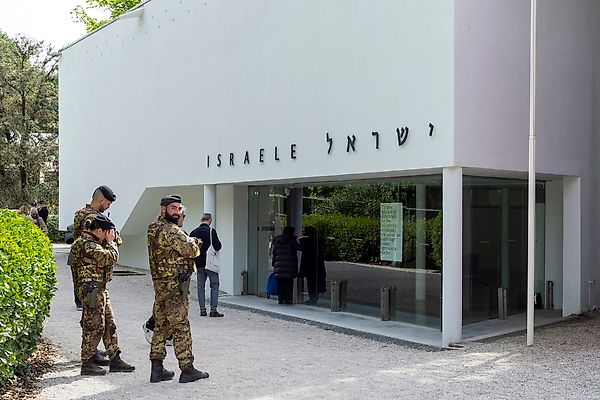
Seventy-three artists and curators participating in the Sixty-FirstVenice Biennale’s main exhibition, set to open May 9, have issued on open letter objecting to organizers’ decision to “exceptionally” move the Israeli pavilion to the Arsenale, saying its presence there will foster an intimidating atmosphere that conflicts with the inclusive mandate of the show’s late curator, Koyo Kouoh, who died unexpectedly last summer. As well, the group called for the exclusion of “current regimes committing war crimes,” including Russia and the US. Among the letter’s signatories are Gabe Beckhurst Feijoo, Rasha Salti, and Rory Tsepayi, three of the curators tasked with realizing Kouoh’s vision, as well as Gala Porras-Kim, Alfredo Jaar, Nina Katchadourian, Khalil Joreige, Walid Raad, and Himali Singh Soin. A number of artists signed anonymously.
“To insert the Israeli pavilion into spaces alongside the main exhibition, ‘In Minor Keys,’ conceived by Koyo Kouoh, intrudes upon and goes directly against Kouoh’s curatorial vision, her curatorial statement, and the principles of ‘radical solidarity’ she articulated so clearly in all her work,” wrote the group. “This will also introduce conditions of violence and fear through the military and police presence that will accompany the Israeli pavilion.”
“La Biennale has made a statement of neutrality and we submit in response that allowing governments that are actively committing war crimes, atrocities and genocide to participate is not neutral. A community of nations can only exist if states are sanctioned when they egregiously violate international law and human rights. As the largest and most visible art event in the world, a position taken by La Biennale has enormous impact. While it may be beyond the power of an exhibition to bring justice to all our concerns, there are ethical lines that can be drawn, and actions that cannot be normalized.”
In demanding that Israel, Russia, and the US be barred from showing, the letter writers reiterated and expanded an earlier call for Israel to be excluded from the event altogether owing to its genocide of Palestinians in the Gaza Strip. The group pointed to the Biennale’s previous exclusion of Russia over its attack on Ukraine, in 2022–24 (the country withdrew from the 2022 edition), and South Africa over apartheid, in 1968–93 as precedents, noting that the Biennale in 1974 closed all national pavilions and renamed the main show “Freedom to Chile; for a democratic and anti-fascist culture” as Chile struggled under the military dictatorship of Augusto Pinochet.
Biennale officials have not yet publicly responded to any demands from participants regarding Israel’s statues at the event. In an announcement issued in early March naming all participants, organizers issued a press release that read in part, “In response to the communications and requests for participation from countries, La Biennale di Venezia rejects any form of exclusion or censorship of culture and art.
“La Biennale, like the city of Venice, continues to be a place of dialogue, openness, and artistic freedom, encouraging connections between peoples and cultures, with enduring hope for the cessation of conflicts and suffering.”