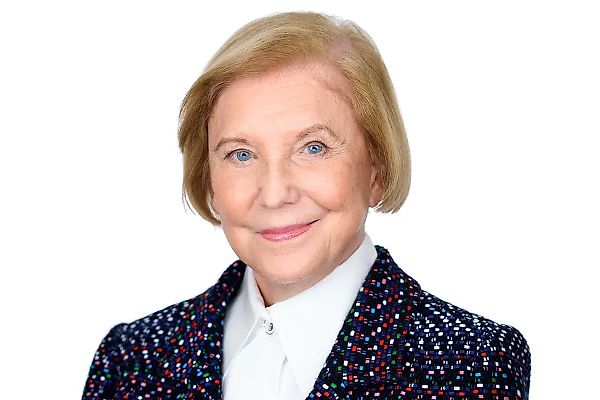
Marica Vilcek, an art historian who, with her husband Jan, cofounded the grant-making Vilcek Foundation, died on Monday in New York. She was 89, according to the foundation, which said she died peacefully at her home. The Vilcek Foundation is an unusual one, since it funds endeavors in both art history and biomedical science, the respective fields of Marica and Jan. Just like the foundation’s creators, both of whom moved from Czechoslovakia to the US, many of the grantees were immigrants—a purposeful choice on the part of the organization, whose mission statement mentions that its activities are meant to raise “awareness of immigrant contributions in the United States.” Related Articles Pat Steir, Famed for Her Abstract 'Waterfall' Paintings, Dies at 87 Agosto Machado, Artist and Activist Whose Shrine Sculptures Kept Queer History Alive, Has Died Countless artists and art historians have benefited from these prizes, whose unrestricted cash purses vary in size. Carmen C. Bambach, the Chilean-born curator of the Metropolitan Museum of Art’s soon-to-open Raphael retrospective, received a $100,000 prize in 2019, and Guadalupe Maravilla, a Salvadorian-born artist who will appear in this year’s Venice Biennale, received a $100,000 one in 2025. Also among the winners of the foundation’s largesse are artists Iman Issa, Nari Ward, Felipe Baeza, and Meleko Mokgosi; Pierre Terjanian, the current director of the Museum of Fine Arts, Boston; and Matthew Bogdanos, whose work for the Manhattan District Attorney’s office has led to the return of many looted artworks previously held within the US. Vilcek said the decision to form the foundation in 2000 came easily. “Jan and I came to realize that our greatest pleasure in life had always been in helping others,” she recalled in a memoir published earlier this year. “Whether I was helping curators with art-historical research, assisting newly arrived immigrants with adjusting to life in America, or encouraging my interns to discover the joy of museum work, I had always felt best when aiding, sharing, and mentoring… So we discussed starting a foundation.” She was born in 1936 in Bratislava, in what was then Czechoslovakia, and studied art history in both her birth city and Prague. After graduating from Charles University, she started at the Slovak National Gallery, working in the prints and drawings department. Through a friend, Marica met Jan on Easter in 1961; the encounter did not leave a lasting mark, but when he met her again at the Slovak National Gallery, they became closer. The year afterward, they married. In 1964, while at a performance of Mozart’s opera The Magic Flute in Vienna, the two decided to defect from Communist Czechoslovakia and promptly left for West Germany, where they received US visas awarded to political refugees. “We left illegally,” Marica told Metropolis. “We didn’t tell my father because the secret police would visit him and it was better for him not to know.” Their actions meant that they could never come back, because if they did, both would face incarceration—they had received prison sentences in absentia. Their families also suffered greatly, with Marica’s brother subsequently sent to work in the salt mines. “That’s how Communism worked—they took it out on your family,” Marica said. In 1965, the Vilceks came to New York, where Jan set up a lab at New York University. Marica, who was able to speak multiple languages, took a role at the Met, working in the department of accessions and catalogs. She stayed on at the museum for 32 years, telling Metropolis that her coworkers helped her feel at home in a country where she was not born. “The museum was a tight-knit place and I never considered myself an immigrant or a refugee,” she said. “In the museum, it didn’t matter.” In the coming decades, she served as a consultant to the Commission for Art Recovery of the World Jewish Congress, the Jewish Museum in New York, and the Jordan National Gallery in Amman. She also supported NYU’s Institute of Fine Arts, joining its board in 2013 and, with Jan, underwriting a curatorial program there in 2018. Since 2021, the IFA’s Great Hall has been named after Marica. At the time, NYU president Andrew Hall said of her, “Marica has steadfastly supported the Institute’s mission: excellence in scholarship, and development of the next generation of leadership in art history and curation, archaeology, and conservatorship.”