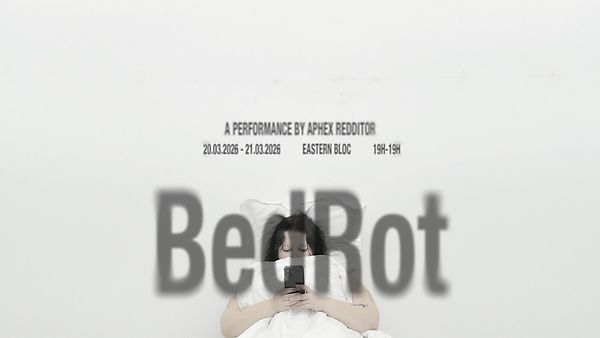
On Saturday, a performance by an artist who goes by the alias Aphex Redditor went viral on social media after she laid down and continually scrolled through Instagram Reels for 24 hours. But as the performance gained attention on Instagram and X, another artist, Qualeasha Wood, accused Aphex Redditor of copying a similar performance she had staged the year before. In March 2025, Wood staged a performance called Attention Economy at London’s Pippy Houldsworth Gallery, whose release for the exhibition also explicitly invoked the term “bed rotting,” which refers to the act of staying in bed for prolonged periods of time without doing much at all. A screen showing a feed from Wood’s phone appeared alongside her. In September, she repeated the performance at the Victoria & Albert Museum in London. Related Articles Agosto Machado, Artist and Activist Whose Shrine Sculptures Kept Queer History Alive, Has Died Cesar Chavez Mural Painted Over in San Francisco Amid Growing Fallout from Abuse Allegations That performance appeared alongside tapestries featuring layered images of the artist, recalling the way pictures are often overlaid in one’s browser. Those tapestries have gained Wood widespread attention: one that appeared on the cover of Art in America, ARTnews’s sister publication, was acquired by the Metropolitan Museum of Art. Aphex Redditor’s performance was titled BedRot; it took place at Eastern Bloc, an art center in Montreal, between Friday and Saturday. Similar to Wood’s performance, a screen showed what Aphex Redditor saw as the artist scrolled through Instagram Reels. On X, BedRot became the subject of fascination. “I am the only person watching her bed rot on reels in this art gallery at 2AM,” read one post that has since gained more than 66,000 likes. “Oh I love seeing my work copied word for word bar for bar,” Wood responded. Later, on Instagram, Wood wrote, “Idk yalllllllllll there’s just something about when yall (collective) see a Black Woman doing something you dismiss it but when you see the exact same thing happening but in pale skin it becomes romanticized. Viral. It’s almost exactly like that was the point. I wouldn’t expect to go viral for something im not allowed to participate in. Because rest IS political 😉 and it is a privilege ;).” Reached by Instagram DM, Aphex Redditor told ARTnews, “I was not aware of Qualeasha’s work prior to my performance. I had been developing my performance with the gallery since December 2024. As an artist I am very interested in algorithms and my performance was meant to focus on tracking the development of a social media algorithm over a durational period. My practice as a whole is very centred on the internet and online culture, which was my intention with the performance.” The artist continued, “As a very new emerging artist I did not expect to receive this degree of media attention, and I believe Qualeasha deserves the same recognition for her work from the media.” Wood did not respond to a request for additional comment submitted through a representative for Pippy Houldsworth Gallery.