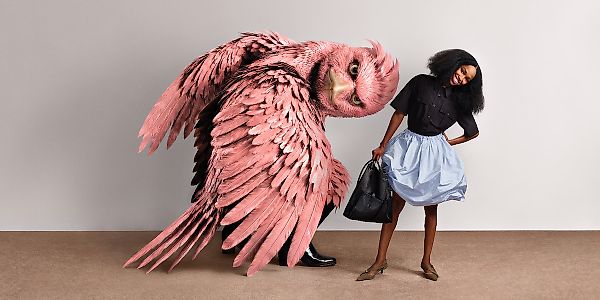
Prada‘s current ad campaign for its Spring/Summer 2026 collection is an unsettling affair, and no surprise its maker is an artist known for disturbing video art and sculptures: Jordan Wolfson, whose past works have featured a gyrating cyborg, chained-up puppets, and other terrors. Wolfson’s art is famous—and, in some cases, notorious—for its depictions of violence, both of the physical and emotional variety. A VR work that he produced for the 2017 Whitney Biennial, for example, allowed visitors to witness a man being bludgeoned by a version of Wolfson himself wielding a baseball bat. Another VR work made last year for the Fondation Beyeler, a museum just outside Basel, Switzerland, body-swapped its participants, without much warning to viewers in advance that this would happen. Related Articles Jordan Wolfson Makes Puppets of His Viewers with a New Work in Basel Miuccia Prada Taps Video Artist Cécile B. Evans for Installation at Paris Fashion Week Mercifully, the Prada campaign includes no such instances of carnage, but it does maintain Wolfson’s ongoing fascination with bizarre digital avatars. Its still images feature a range of models—including the actors Carey Mulligan, Nicholas Hoult, and Damson Idris—standing beside larger-than-life birds that seem more than a little menacing. Wolfson first made his name as a video artist, and the Prada campaign also includes a short moving-image work that is billed as his first foray into the medium since Riverboat Song, his acclaimed 2017–18 piece. In the new video, Prada’s models numbly into the word “I” a few times, then at last utter the phrase “I am.” These words also constitute the title of the campaign, which is called “I, I, I, I AM… PRADA.” As Wolfson’s subjects say those words aloud, the birds nearby them—which appear to be computer-generated, or at least computer-altered, given their sheen and their unnatural size—slowly move around. When the actress and model Hunter Schafer appears here, a bird-man hybrid with black leather boots ominously raises its hands behind her, gazing directly at the viewer while breathing deeply. Schafer, beaming, does not seem to notice the creature behind her. In a statement accompanying the campaign, Prada praised Wolfson’s contribution for opening “ceaseless possibilities, multiplicities of identity and being, of what Prada can be, how it can be perceived, and re-perceived, through constantly-questioned conventions of an advertising campaign.” This seems like a twee reading of a campaign that is designed to creep out and entrance in equal measure. If anything, Wolfson’s newest works seem to undermine fashion brands’ unique ability to defang the art produced for collaborations. Brands from Dior to Louis Vuitton have in recent years tapped artists such as Carrie Mae Weems, Cosima von Bonin, Tyler Mitchell, Cindy Sherman, Nan Goldin, Julien Nguyen, and Isabella Ducrot—to name just a few—for collaborations in recent years, both to produce fresh works for runway shows and to help conceive ad campaigns like the new one by Prada. The trend led Art in America’s Emily Watlington to write, in 2024, “We should be asking, is fashion supporting the arts or is it subsuming them?”