Nearly 200 Venice Biennale Participants Call for Israel to Be Barred from Exhibiting
43March 19, 2026
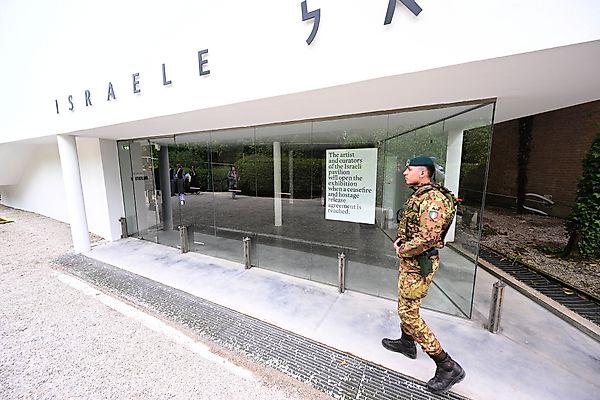
One hundred eighty-three artists, curators, and art workers participating in the Sixty-FirstVenice Biennalehave signed anopen letterdemanding that Israel be excluded from the event, saying that the Biennale’s “complicity with the attempted destruction of Palestinian life must end.” Among the signatories to the missive, which was organized by the Art Not Genocide Alliance (ANGA) are artists Sophia Al-Maria, Yto Barrada, Merriam Bennani, Alfredo Jaar, Tal Shani, and Cauleen Smith. Two of the exhibition’s curators, Gabe Beckhurst Feijoo and Rasha Salti, both of whom were selected by the Biennale’s late curator, Koyo Kouoh, to carry out her vision for the main show, “In Minor Keys” signed as well. The signatories represent more than thirty countries.
The call comes as the Biennale is already under pressure to exclude Russia. It is the second time ANGA has pushed back against Israel’s presence at the 2026 Biennale, which is set to open May 9. The organization in October 2025 petitioned the board and president of the Biennale to exclude the country, after the Israeli Ministry of Culture issued an open call for artists and curators to represent it. Despite ANGA’s threatened boycott, officials pressed on, selecting Romanian-born artist Belu-Simion Fainaru, who lives and works in Haifa, to represent Israel. Fainaru earlier this year told Artnews that his pavilion would represent “a vision of hope and human feeling, the total opposite of boycott and exclusion, giving space to everybody”.
ANGA in 2024 secured more than 24,000 signatures in its drive to bar Israel from the Sixtieth Venice Biennale. Ruth Patir, the artist representing the country at that Biennale, and Mira Lapidot and Tamar Margalit, curators of the Israeli pavilion, canceled their exhibition there, saying the pavilion would remain closed until a cease-fire was obtained and the hostages released. The pavilion did not reopen during the Biennale’s run.
Biennale officials have not responded publicly to the letter. In an announcement issued earlier this month naming all participants, organizers issued a press release that read in part, “In response to the communications and requests for participation from countries, La Biennale di Venezia rejects any form of exclusion or censorship of culture and art.”
“La Biennale, like the city of Venice, continues to be a place of dialogue, openness, and artistic freedom, encouraging connections between peoples and cultures, with enduring hope for the cessation of conflicts and suffering.”