Pathbreaking Austrian Postwar Painter Arnulf Rainer Dies at 96
97Dec. 24, 2025
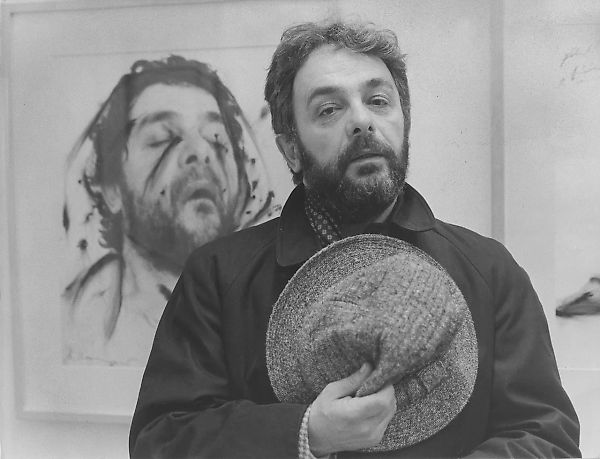
Arnulf Rainer, whose work provided crucial inspiration to the Viennese Actionists, died on December 18 at the age of ninety-six. His death was confirmed by gallery Thaddaeus Ropac, which represents him. Though best known for his psychologically intense “Übermahlungen,” or overpaintings, Rainer’s experiments touched on Surrealism, minimalism, and Abstract Expressionism, among other genres; throughout, he remained firm in his conviction that art should confront pain, suffering, and violence. Process, which he viewed as a meditative practice, was of tremendous import to him, and he frequently pushed himself to exhaustion to achieve the state in which he could best express himself. According to Rainer, “The organic act of creating is perhaps more essential than the completed painting; for this progressive participation in the obscuration or immersion of the painting, its gradual return to peace and invisibility (the great Ocean) could be compared to the contemplative experience of religious life.”
Arnulf Rainer was born in Baden, Austria, on December 28, 1929. In the 1940s, he moved to Vienna, where he briefly attended art school before dropping out in disgust. Among his earliest works are the “Zentralgestaltungen” (central compositions) of the late 1940s, for which he adopted the signature TRRR, meant to evoke the snarl of a dog. The “Kritzelexpressionen” (scribble expressions) and “Blindzeichnungen” (blind drawings) of 1949–52 responded to the Surrealist notion ofécriture automatique, while his “Proportionen” (proportions) and “Reduktionen” (reductions) of the next few years comprised monochrome black canvases with white geometric elements.
Lacking funds, Rainer began to trawl the city’s local flea markets for old paintings, which were cheaper to buy than fresh canvases. Atop these, in the early 1950s, he began making his “Übermahlungen,” densely overlaying the works with broad, gestural, monochromatic brushstrokes, typically black or red, leaving only a small part of the original canvas peeking out. Through this method of simultaneous creation and destruction, he invited new readings—and stymied old ones—of works ranging from copies of old masters to photographic self-portraits to documentary images depicting the atrocities of World War II. “Just as a dream, for instance, continues in deep sleep,” wrote Rainer in 1973, “overpainting is the development of . . . autocommunication in silence—a communicable silence.” Writing in 2016, Hans Hans-Jürgen Hafner characterized the works as operating at the intersection of “aggression and therapy, destruction and correction.”
In the 1960s, Rainer began creating his “Selbstdarstellungen,” or self-exposures. These comprised photos of himself, taken under the influence of LSD or alcohol, in which he violently contorted his face or body; he then altered the prints with oil crayon and ink, recalling defaced street posters. “If Rainer had stopped at just the photographs, the results would have been hilarious, melancholic, and tinged with what the viewer would perceive as a theatricalized madness. However, by pushing them even farther he has transformed them into something else, something unexpected and startling,” wrote John Yau in a 1986 issue of Artforum. “In the self-portraits, the myth of the artist as social/asocial animal is examined with the thoroughness of a coroner. Gesture becomes a potent, self-reflexive tool.”
Rainer’s work gained attention from his peers before he was known outside Austria, notably inspiring a 1960 short by Austrian filmmaker Peter Kubelka. Titled Arnulf Rainer, it is one of the earliest flicker films and a foundational structural film work. By the 1970s, Rainer had begun to receive international acclaim, fueled in part by one of the first retrospectives of his work, in 1968, at the Museum des 20. Jahrhunderts in Vienna. He participated in three editions of Documenta—in 1972, 1977, and 1982—and in 1978 represented Austria at the Venice Biennale. He was awarded the Grand Austrian State Prize that same year. In 1981, he was elected a member of the Academy of Arts in Berlin. From 1981 to 1995, he was a professor at the Academy of Fine Arts in Vienna—the same school he dropped out of. In 1993, the Arnulf Rainer Museum opened in New York, exhibiting over one hundred and fifty of his works over a two-year period. In 2002, the Pinakothek der Moderne in Munich dedicated a room to Rainer, where his work remains on permanent display. The Arnulf Rainer Museum, devoted to his work, opened in his native Baden in 2009: The institution hosted a retrospective of his work last year, in celebration of the artist’s ninety-fifth birthday.