Conceptual Artist Franco Vaccari, Whose Work Presaged Social Media, Dies at 89
83Dec. 19, 2025
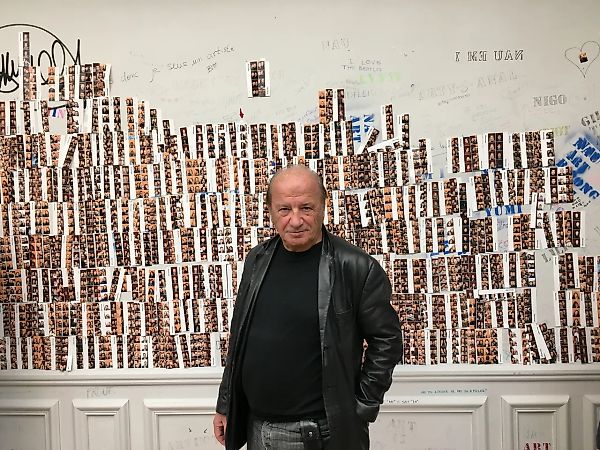
Italian Conceptual artist and theoristFranco Vaccari, whose participatory photographic works presaged the logics of social media and helped photography gain recognition as an art form, died on December 12. He was eighty-nine. His death was announced by the Bologna gallery P420, which represents him. Veronica Santi, writing in a2020 issue ofArtforum, characterized Vaccari as working with “[e]yes wide-open, challenging our increasingly bland, flattened, and frenetic reality.” He rejected the traditional concept of the artist as a solitary genius, instead making the public complicit in what he termedesposizioni in tempo reale, or “exhibitions in real time,” which, owing to the incorporation of audience feedback, he saw as distinctly different from Happenings or performances. His exhibitions routinely upended conventional notions of what constitutes an artwork, placing him squarely within the Conceptualist tradition and making him one of Italy’s best-known artists.
Franco Vaccariwas born June 18, 1936, in Modena, Italy, where he would live all his life. He obtained a degree in physics before beginning to photograph street graffiti, which he viewed as an anonymous form of poetry. He showed these as his earliest works beginning in the mid-1960s. For the 1969 performance ofMaschere, staged at the Galleria Civica in Varese, in northern Italy, he handed out masks of segregationist Alabama governor George Wallace to spectators in a dark room. Vaccari then randomly shined a flashlight about, snapping photos of those caught its beam. Many attendees instinctively covered their faces with the masks as they sought to escape the glare. “Thus, the observer became the object of observation, like an animal hunted down by the camera, ready to take refuge behind the impersonality of the mask, in flight from the artist’s invasive power,”wrote Alessandra Piosella inArtforumin 2007.
Vacarri’s Real-time exposure #4. Leave a photographic trace of your passage on the walls, 1972, perhaps his best-known work, was presented at that year’s Venice Biennale. It consisted of a photo booth set next to a wall, to which the artist had affixed a picture of himself taken by the machine. Visitors were encouraged to get their own pictures taken in the booth, and to place these alongside his self-portrait. “The automatism of the shot upsets the hierarchical relationship between author and tool, while its instantaneousness suggests the idea of a new co-presence and collaboration between artist and audience,” wrote Emanuela Zanon in a 2020 issue of Juliet.
Another 1972 work, 700 km of exhibition Modena Graz, comprised photos Vaccari shot out the window of a moving car as he drove from Italy to Graz, Austria. This work fell under the rubric of what he termed minimi viaggi, or “minimal journeys,” as did the 1974 Omaggio all’Ariosto (Tribute to Ariosto), for which he retraced by car the poet’s steps between Carpi and Ferrara, taking Polaroids, pasting them to postcards, and sending these to the Palazzo dei Diamanti, in Ferrara, which had invited him to participate in an exhibition dedicated to Ariosto.
Dreams came to be a favorite subject for the artist in later life. For the 2020 installation Migrazione del reale (Exodus of the Real), Vaccari photographed notebooks in which he had recorded his dreams each morning since the early 1980s, printing the photos on canvas and embellishing them using colored pencils. He also made works featuring bar codes and QR codes
Vaccari, a theorist as well as an artist, wrote extensively on the work of Duchamp. He participated in two more iterations of the Venice Biennale, in 1980 and 1993, as well as the 2010 edition of the Gwangju Biennale. A major retrospective of his work is slated to open at the Museion in Bolzano, Italy, this spring.