Artists Rally for First Amendment Rights at NYC’s Federal Hall
92Dec. 18, 2025
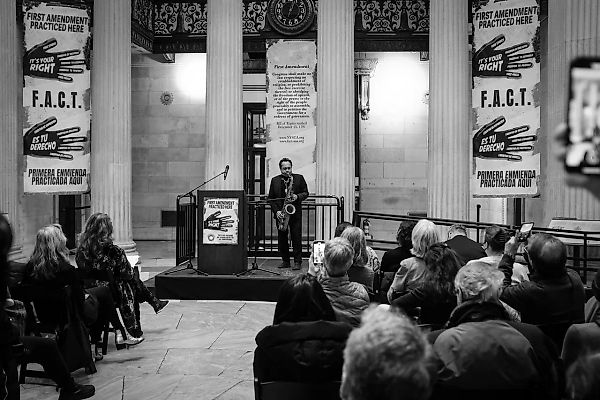
On December 15, artists, musicians, cultural workers, and local politicians gathered inNew York’sFederal Hall, where the Bill of Rights was introduced, to defend artistic rights in the US. Under the rallying cry “TheFirst Amendmentwas born here; we will not let it die here,” some fifty participants called for December 15 to be recognized as “First Amendment Day.” The action was co-organized by the National Coalition Against Censorship, New Yorkers for Culture & Arts, and the First Amendment Culture Team (FACT).
Though turnout was light, spirit was strong. Among the speakers and performers were Mexican American artist Felipe Galindo Feggo, whose 1999 work4th of July from the South Borderwas removed last summer from public display at the Smithsonian’s National Museum of American History after the White House objected to it. Cuban American artist Coco Fusco read the Fourteenth Amendment, and other contributions came from poet and playwright Carl Hancock Rux and First Amendment scholar George Emilio Sánchez.
One participant was Karen Finley, a member of the NEA Four, a quartet of performance artists who sued the National Endowment for the Arts in the early 1990s after their grants were revoked owing to a “decency clause” instituted by a Republican-led Congress. Though the group initially won their case, the Supreme Court later ruled in favor of the NEA’s decision-making process, and the organization stopped funding individual artists. “Our case really was a precedent because it decided that the government could deny funding or support based on ‘decency,’ and now what do we have? We’re seeing books being banned, we’re seeing what’s happening at universities, with research funding, and in terms of healthcare, whether it’s trans healthcare or reproductive rights,” Finley told Hyperallergic. “So much of what we were fighting for within our own work — what we were creating art to bring awareness about—is now even more in jeopardy.”
Topics brought to the fore at the hourlong rally included book bans, the censorship of artworks, federal funding cuts, issues of accessibility, and recent governmental efforts to erase Black and LGBTQ+ history. Among the organizations pledging solidarity with the action were Arts Equity Group, Art’s House Schools, Brooklyn Arts Exchange (BAX), Caribbean Cultural Center African Diaspora Institute (CCCADI). cultureNOW, Dance Parade, the NYC Cultural Institutions Group (CIG), First Amendment Culture Team (FACT), Franklin Furnace Archive, Lower Manhattan Historical Association, Museum of the City of NY, National Coalition Against Censorship, National Queer Theater, New Yorkers for Culture & Arts, NYC Arts in Education Roundtable, NYS Alliance for Arts Education, and Spear-It.
“Free expression is not a partisan principle, it is a constitutional one,” said Lee Rowland, executive director of the National Coalition Against Censorship in a statement. “When the government targets art or artists for political reasons, every American should be alarmed. We stand with New York’s cultural community in defending the First Amendment.”