Ceal Floyer, Understated Conceptualist, Dead at 57
91Dec. 16, 2025
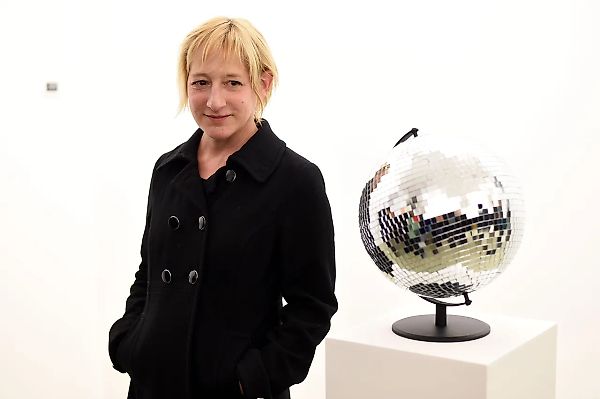
Pakistani-born British Conceptual artistCeal Floyer, known for her discreetly comedic conceptual performances and films and for her works composed of slightly altered mundane objects, died on December 11. Her death after a “long battle with illness” was announced by her galleries, Lisson and Esther Schipper.
One of the upstart Young British Artists to alongside such names as Martin Creed and Gavin Turk in the mid-1990s, Floyer stood apart from her more brashly sarcastic peers with a practice that “examine[d] the intersection of nature and artifice, substance and appearance, distilling her findings into spare, sometimes confounding, but always flawlessly realized images, objects, and situations,” wrote Michael Wilson in a2017 issue ofArtforum.In Floyer’s hands, the light switch, the grocery list, the hammer became revelatory. “Her work is like a finger pointing towards absence, offering magico-circumstantial experiences and small explosive revelations that continue to touch us long after we have left the exhibition halls,” wrote James D. Campbell in a2011 article forFrieze.
Ceal Floyer was born in Karachi, Pakistan, in 1968, and grew up in England. She earned her BFA from Goldsmiths College in London in 1994. Three years later she won a Philip Morris Scholarship to study at the Kunstlerhaus Bethanien and moved to Berlin. Floyer almost immediately proved herself a master of producing maximum impact via minimal means, as embodied for example by her seminal 1994 work Light, a single unlit bulb hung from the ceiling and illuminated by four surrounding slide projectors. Light Switch, 1992–99, comprised a projector beaming a to-scale image of a light switch onto a wall, while a 2006 work, Solo, consisted of a mic stand bearing a hairbrush instead of the expected Shure SM58. The same humorous austerity marked her performances. In Nailbiting Performance, 2001, she stood before an audience chewing her nails into a microphone. The 2005 sound installation ’Til I Get It Right reduced the chorus from a 1972 weeper by Tammy Wynette, “I’ll just keep on falling in love till I get it right,” to “I’ll just keep on till I get it right,” turning a lovelorn plaint into an assertion of will.
Many of Floyer’s works centered on frustrated expectations. Among these was Newton’s Cradle, 2017, which presented the popular office-desk toy with its dangling chrome balls snarled in a knot, the tangle depriving the user of the soothing joy of the sphere’s regular clicks as they knock against each other. Her 2018 video Hammer and Nail showed the battering head of a hammer crashing down repeatedly atop a nail in a plank of wood, the metal shard seeming to disappear into the frame with the last stroke. Experienced in the hush of the white-cube gallery, the accompanying audio could be jarring. Floyer in 2018 explained to Studio International’s Hatty Nestor that the tight framing had been achieved in post-production. “As a consequence,” said Floyer, “the hammer is denied the result of its hammering action, because it’s really the altered framing which appears to raise the plank containing the nail to meet the hammer’s head.”
Floyer was a recipient of the 2007 Preis der Nationalgalerie für junge Kunst, presented by Berlin’s Hamburger Bahnhof, and the 2009 Nam June Paik Art Center Prize. She participated in Manifesta 11 (2016), Documenta 13 (2012), and the Fifty-Third Venice Biennale (2009) and was the subject of solo exhibitions at institutions including the Aspen Art Museum (2016); Kunstmuseum Bonn (2015), Museion, Bolzano (2014); the Museum of Modern Art in North Miami (2010); the Palais de Tokyo, Paris (2009); and KW Institute for Contemporary Art, Berlin (2009). Floyer’s work is held in the collections of major art institutions around the world, among them the San Francisco Museum of Modern Art; the Museum of Modern Art, New York; Museo Jumex, Mexico City; Tate Modern, London; the Neue Nationalgalerie, Berlin; the Toyota Municipal Museum of Art, Japan; and the National Gallery of Victoria, Melbourne.
“Ceal Floyer’s work looks simple; often it looks as if there is nothing to see (although as Duchamp pithily remarked, one can look at seeing),” wrote Jeremy Millar on the occasion of an exhibition by Floyer at Birmingham, England’s Ikon Gallery in 2001. “Yet, as we have seen, these works can lead us in important directions, allowing us to consider the nature of representation, or the difference between art and non-art. We can accept this challenge; or we can simply smile to ourselves, and appreciate their ‘rightness’ as artworks, however they happen.”