Frank Gehry, Giant of Architecture, Dies at 96
93Dec. 12, 2025
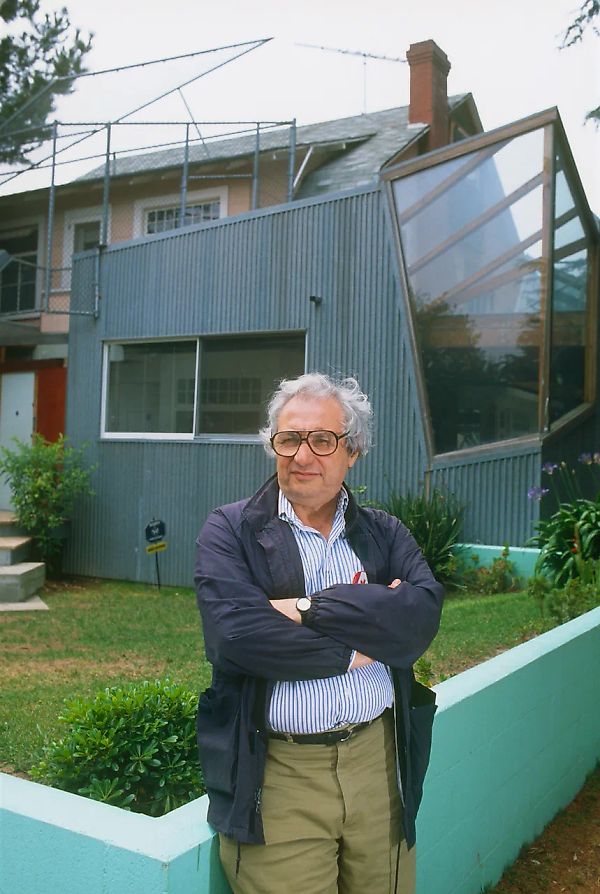
Frank Gehry, a towering figure in the worlds ofarchitectureand design, died at his home in Santa Monica, California, on December 5, after a brief respiratory illness. Over the course of his eight-decade career, Gehry altered the look of modern cities with his ebulliently sculptural public buildings, becoming one of the best known and most acclaimed American architects of the twentieth century. Structures like the Guggenheim Museum Bilbao, in Spain, and the Walt Disney Concert Hall, in Los Angeles, are among the most widely recognized in the world, placing him in a pantheon alongside such figures as Frank Lloyd Wright, Le Corbusier, Mies van der Rohe, and I. M. Pei. “I’ve always been for optimism and architecture not being sad,” Gehry told NPR in 2004. “You know, a building for music and performance should be joyful. It should be a great experience and it should be fun to go to.”
Frank Gehry was born Frank Owen Goldberg on February 28, 1929, in a working-class section of Toronto, to Jewish immigrants from Eastern Europe. As a child, encouraged in his natural creativity by his maternal grandmother, he constructed cities from cast-off scraps of wood obtained from his maternal grandfather’s hardware store. The humble items sold there would profoundly influence his practice, which early on was characterized by the use of such mundane materials as corrugated steel, chain-link fence, and plywood.
In 1947, the family moved to California, where Gehry got a job driving a truck and studied at Los Angeles City College. He graduated from the University of Southern California’s School of Architecture in 1954, by now having adopted the surname Gehry to dodge rampant antisemitism. After a stint in the army, he enrolled in the urban-planning program at Harvard University’s Graduate School of Design. He then dropped out and returned to Los Angeles, where he worked for Gruen Associates, a designer of shopping malls, before opening his own office in 1962.
Having fallen in with California artists Edward Kienholz, Robert Irwin, and Ed Ruscha, Gehry began pushing his own practice outside the bounds of the modern idiom, at first creating private spaces from modest materials put to inventive uses. His 1965 Danziger Studio, a live-work space on Melrose Avenue, featured an uninterrupted stucco façade that blended seamlessly into the urban surrounds. Alongside his architectural efforts, he pursued a career in design, which is how he first rose to international prominence, thanks to his Easy Edges series of 1969–73. This gracefully curved functional furniture was made from corrugated cardboard; one piece, the Wiggle Side Chair, recalled a piece of ribbon candy set on its edge.
In 1977, Gehry purchased his own home, a small bungalow in Santa Monica whose stark redesign, incorporating large sheets of corrugated steel and smooth glass set in sharply angled wood frames, would serve as the template for many other buildings he created in the 1980s, as well as the inspiration for countless imitators. Commissions flooded in, and in 1988 he participated in the “Deconstructivist Architecture” exhibition at the Museum of Modern Art and was the subject of a retrospective at the Whitney Museum of American Art, both in New York. The following year, he completed the Vitra Design Museum in Germany, a pleasing, white-walled jumble of towers, cubes, and ramps, and was awarded the Pritzker Prize, architecture’s most prestigious honor.
The 1990s saw Gehry focus on architectural applications of the serpentine sculptural forms that were the hallmark of his furniture designs, most notably in the Guggenheim Museum Bilbao, completed in 1997 and widely hailed as a masterpiece. It was around this time that he designed another of his best-known buildings, the Walt Disney Concert Hall, with its riotous assemblage of reflective, arcing, silvery forms, which wasn’t built until 2003.
Though he originally sketched his designs freestyle, Gehry was an early adopter of computer-aided design. This became evident in his 1992 commission for the Summer Olympics in Barcelona, Spain, a monumental fish-shaped public sculpture; a reiteration of his Fish Lamps, made for the Formica Corporation in the 1980s, it embodied an ichthyic theme that would to fascinate him throughout his life. Other projects relying heavily on digital design were the 76-story 8 Spruce Street (2010) in Manhattan, whose undulating exterior curtain walls appear 3-D printed, and the cloud-like glass agglomeration of the Fondation Louis Vuitton in Paris (2006).
At his death, Gehry was working on several projects, including a luxury goods store in Beverly Hills, an exhibition space in Paris, and a concert hall in Los Angeles. “People blame architecture for a lot of things today—they complain that every city looks the same. Well, I agree, but architecture isn’t what’s building our cities anymore,” he told Artforum’s Julian Rose in 2018. Our cities look that way because of economics, because of politics, because of development. Maybe if we thought about architecture as art again we could start to change that.”