Elke Solomon (1943–2024)
249Jan. 23, 2024The names
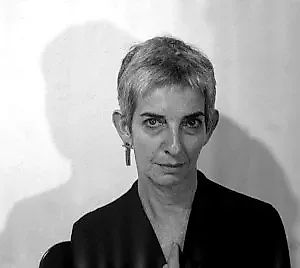
Interdisciplinary artist, curator, author, and educator Elke Solomon, known for her abstract paintings and cutouts, and for her humorous one-woman performances exploring issues such as class, property, and anti-Semitism, died at home in Manhattan on January 9 following a long struggle with cancer. She was eighty. A curator in the prints and drawings department at the Whitney Museum of American Art during the 1970s, she inaugurated the museum’s ground-floor exhibitions and cocurated the first Whitney Biennial.
Solomon taught at the Parsons School of Design for over forty years. She was a founding editor of the seminal feminist journalHeresies: A Feminist Publication on Art and Politics, and, for nearly two decades, a member of New York’s A.I.R. Gallery, the first all-woman cooperative gallery in the US.
Her work frequently combined a love of food and Jewish tradition with a talent for raucous comedy. “Solomon’s art wants to agitate, provoke, incite, and she’s got a surplus of the ingredients needed for this yield,” wrote Carrie Rickey in a 1979 issue ofArtforum. “[French philosopher Hippolyte] Taine said, ‘We know a million facts, yet know nothing.’ Solomon seems to say, ‘We’re aware of a million indignities, yet can’t help our own complicity.’ By devastating her audience, Solomon makes us too weak for complicity and too depleted for action. She traps us in a classic double-bind: if we laugh, she can accuse us of being monsters; if we don’t laugh, we’d be challenged, ‘Can’t you take a joke?’”Related2024 VENICE BIENNALE: MOROCCAN PAVILION SHAKEUP, GERMANY ANNOUNCES ARTISTSORLANDO MUSEUM OF ART IN DIRE FINANCIAL STRAITS FOLLOWING FAKE-BASQUIAT KERFUFFLE Elke Solomon was born April 10, 1943, in Rochester, New York, and spent her youth in Detroit. She earned her BA and MA in art history and painting from the University of Michigan, where she studied under a number of noted art historians, including Eileen Forsyth, Oleg Grabar, and Paul Grigaut.
She launched her curatorial career in 1966, in the department of art and archaeology at Princeton University. In 1970, she joined the Whitney, organizing solo shows for artists including John Altoon, Chryssa, Alex Katz, Alice Neel, Ann Shapiro, and Wayne Thiebaud, among others. She left the museum in 1976 but continued curating through Independent Curators International and on a freelance basis.
In 1977, Solomon began making abstract paintings and drawings, which were characterized by their black-and-white palette and architectural nature. She also began writing and producing the solo performances for which she would become known. Of Solomon’s foray into performance art, artist and Founding Director Emerita of Franklin Furnace Archive Martha Wilson noted, “During the 1980s, the term ‘social practice’ had not yet emerged for works which dealt directly with misogyny, AIDS, or class disparity. We were just getting used to the term, ‘performance art,’ to describe time-based practice that dealt with a wide range of subjects, often in confrontational ways.
Elke Solomon practiced her work during this time, pursuing her feminist perspective while influencing a wide range of people both inside and outside the art world.” Acerbic and witty, Solomon was unafraid to poke fun at the tenets of society and religion. A sample joke fromTunafish Tales, 1978: “One of the advantages to being Jewish in America is the time saved in searching for pork in a can of pork and beans.” Writing on the show the following year, Rickey noted, “Twentieth-century performance has found inspiration in dance, music, cabaret and theatre, but no one to my knowledge has ever before found inspiration in talk-show schtick. Elke Solomon does.
An accomplished painter, draughtsperson, conceptual artist and curator, Solomon [performs her] Catskills-cum-Vegas monologue with the outrageousness of Joan Rivers delivering an encyclical to a constituency including the pontiff, the ayatollah and Johnny Carson.” Solomon in the early 2000s turned her attention to cutouts and stencils, typically illustrating objects found in Western culture in abstract form. Unlike her earlier works, these were vibrantly colored. She also made sculptures, often incorporating kitschy or inexpensive materials.
In 2013, Solomon teamed up with her son, painter Alex Kwartler, for a two-person show in which they presented individual and collaborative works. Writing on the latter inArtforum, Ryan Steadman commented, “It is unsurprising that [Solomon and Kwartler’s] collaborative collage paintings work so well. Shreds of photographs, all of which were taken during a screening of the movieRenoir, 2013, dance across the surface of these small painted panels.
Despite their simple two-step process, the works include a remarkable variety of paint handling and compositional moves. One untitled panel features fragments of classical nude imagery nestled inside a dark, spiraling vortex. It’s a lovely and vexing picture that glows with corporeal magic.
This work—the entire show in fact—reminds us that even in a throwaway society the artist will always find a way to pay homage to nature and beauty.” In addition to her long tenure at Parsons, Solomon taught at numerous universities and colleges, including Bard College, Columbia University, Hampshire College, the Pennsylvania Academy of Arts, Princeton University, the School of the Art Institute of Chicago, and the Yale University School of Art. Her work is held in the collections of major arts institutions including the Museum of Modern Art, the Brooklyn Museum, the Metropolitan Museum of Art, all in New York; the Museum of Contemporary Art Chicago; the Philadelphia Museum of Art; the Yale University Art Gallery, New Haven; the Cincinnati Art Museum; and the Milwaukee Museum of Art. Solomon did not let her illness prevent her from making work, continuing to recite jokes from a vast collection of Jewish humor in deadpan appearances on her YouTube “Bar Mitzvah Lounge” until just weeks before her death. In addition to her son, she is survived by her husband, architect and urban planner Michael Kwartler..