Des Moines Art Center to Destroy Watershed Land Art Work by Mary Miss
188Jan. 18, 2024
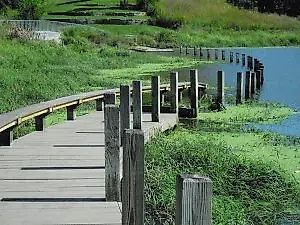
The Des Moines Art Center will tear down Mary Miss’sGreenwood Pond: Double Site, 1989–96, an outdoor installation believed to be the first urban wetland project in the United States. The Cultural Landscape Foundation (TCLF), a national and advocacy nonprofit based in Washington, DC, reports that Art Center director Kelly Baum, whoassumed leadershipof the institution this past May, notified Miss of the impending action on December 1. The museum commissioned the work from Miss for its permanent collection in 1994, at which time it contracted with the artist to “reasonably protect and maintain the project against the ravages of time, vandalism and the elements.”RelatedBRENT SIKKEMA (1948–2024)FRANCE APPOINTS RIGHT-WING CULTURE MINISTER Composed of materials including treated wood, metal mesh, and concrete,Greenwood Pond: Double Sitesurrounds a lagoon that sits on city-owned Greenwood Park, just behind the Art Center, which also occupies the park. The work allows visitors to explore the natural surroundings via a multilevel gravel and boardwalk path system that curves along the edge of the pond, which is planted with wetland grasses.
Two ramps diverge from the system, one entering the water, and the other allowing visitors to descend into a concrete-lined trough that places them at eye level with the water’s surface. A variety of structures—including a large, covered pavilion, a seating area, an arched wooden trellis, a small bridge pavilion, and a stepped stone terrace—provide gathering and resting places. The Art Center in an October 20, 2023, Facebook post and in apress releaseissued four days later apprised the public that access toGreenwood Pond: Double Sitewas temporarily suspended while the museum conducted a “complete structural review.” In the press release, the museum promised to provide “the latest updates and information” on the installation’s fate via itsFacebook page. To date, no information regarding the work has been posted to social media.
TCLF has designated the installation an “at-risk” nationally significant cultural landscape. The organization had placed it on its “at-risk” list back in 2014, but removed it after the work wasrepairedthe following year as part of a larger renovation of the park. Though the work’s materials are less durable than those of other commissioned works on the museum’s grounds—a trio of stone cairns by Andy Goldsworthy, a set of granite blocks by Richard Serra, and bronze sculptures by Henry Moore and Bruce Nauman, respectively—they are, as theDes Moines Registernoted in an October 19, 1996, article published the day Miss’s work was unveiled, “all easily repaired or replaced.” “Women’s lives and stories have endlessly been allowed to vanish so easily,” Miss wrote to Baum on December 3. “Would a man’s work—one of my colleagues’ who might so easily be considered a ‘master’—be allowed to disappear without a trace?” Reached for comment, Art Center spokesperson Amy Day supplied a copy of a January 17 letter sent to Miss by the Art Center and its board of trustees, noting that the Art Center had signed a 1990 agreement with the city, which owns the land on which the contested work sits, agreeing to “correct any unsafe conditions within a work of art sited inside Greenwood Park.” The contract gives the city the right to demand that an unsafe work be removed; whether it called for the removal of Miss’s work remains unclear.
Contending that it had performed regular maintenance and, in 2015, a partial repair of the work, the Art Center held that the wood employed in the original work should have been of a more durable nature, that the cost of rebuildingGreenwood Pond: Double Sitewould be prohibitively expensive, and that doing so would be outside the remit of “reasonable maintenance.” The institution additionally supplied the statement below, on behalf of itself and its board. “Public art commissions are partnerships, and their success requires constant review and dialogue between each stakeholder—in the case ofGreenwood Pond: Double Site, these stakeholders include the Art Center, the artist Mary Miss, and the City and citizens of Des Moines. The Art Center takes its responsibilities to its partners very seriously, and in the last several months, it has been engaged in frequent conversations with Mary Miss and the City—building on many years of dialogue. Regrettably, for a variety of well-researched and long-documented reasons—principally those concerning structural integrity and public safety, all related to the original choice of materials, their proximity to and/or immersion in water, and their exposure to the harsh Iowa weather—the Art Center finds it necessary to removeGreenwood Pond: Double Sitefrom its current location in Greenwood Park.
The Art Center has devoted considerable resources toGreenwood Pond: Double Siteover many years, from the original commission to the present day, and it regrets very much that this outdoor environment has deteriorated to the point where multiple elements are unsafe to remain open to the public and are no longer salvageable. We appreciate that this is very difficult for Mary Miss, and we are committed to doing all that we can to honor both her legacy and the legacy of the remarkableGreenwood Pond: Double Site.” The above story has been amended to include the Des Moines Art Center’s response..