Llyn Foulkes, Art-World Misfit Who Took On Mickey Mouse, Dies at 91
66Nov. 25, 2025
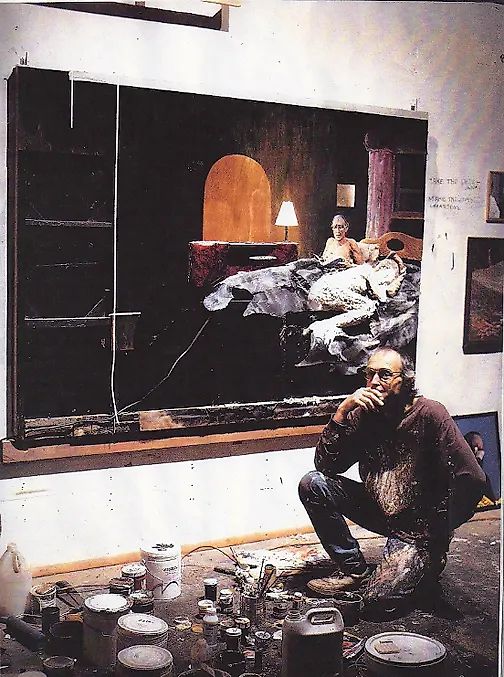
Painter, jazz musician, and assemblage artist Llyn Foulkes, known for his uncategorizable work and his resistance to the commodification of art, died on November 25. He was ninety-one. His death was announced by Kent Fine Art, which represents him. During a career spanning seven decades, Foulkes created a vast and diverse body of work bound together by his use of humor and satire to address subjects that many considered dark or outright taboo. Chief among these was the sacrifice of childhood upon the altar of commerce, performed by such capitalistic megaliths as Disney, whose Mickey Mouse figured prominently in his oeuvre. Foulkes saw the cartoon character as the embodiment of commercialization, which was both the appeal and the danger: “I know that people like to see Mickey Mouse . . . . So the tendency is wanting to keep putting Mickey Mouse in there because then people are going to buy it, and that bothers me,” he told Paul Karlstrom in a1997 oral history interviewfor the Smithsonian’s Archives of American Art. “I just know that I’m actually getting to the point where I’m not even sure that I want to start even using imagery in my painting anymore.”
Llyn Foulkes was born in Yakima, Washington, on November 17, 1934. While studying music and art at Central Washington College of Education, Ellensburg, he was drafted into the US Army, serving two years in postwar Germany. On his return to the States, he moved to Los Angeles, where he studied at the Chouinard Art Institute (now the California Institute of the Arts) until 1959.
Foulke’s early works recall Pop art and often incorporated ephemera such as postcards and vintage landscape paintings. By the late 1960s, he had adopted the practice of applying and removing paint with a rag. The resulting works proved popular, leading Foulkes to abandon the method. He began creating assemblage portraits in which subjects’ features are misshapen or obscured. In the “Bloody Heads” series, originating in 1971, figures often break out of the frame, with a necktie or a hand extending beyond its confines. The 1980s brought the addition of fabric to his oeuvre, lending his works a sense of depth. It was around this time, amid the corporatization of American commercial life, that Mickey Mouse became a staple subject. Pop, 1985–90, perhaps Foulkes’s best-known canvas of this era, depicts the artist fixedly watching television, while a boy, presumably his son, reads the Mickey Mouse Club pledge. A later work, Untitled-Mickey Eyes, 2021, features the cartoon mouse’s bright, blank, sightless eyes pasted over those of a young man appearing in a found, black-and-white portrait, black paint creeping over his shoulders and diminishing his form.
Religion, too, occupied Foulkes’s sights, as in the painting Join the Club, 2007–11, depicting a Catholic priest above whose collar and crucifix looms a pulped, crimson visage. Politics also frequently enter the work, as in the painting Land for Sale, 2017, which takes up the Trump administration’s efforts to peddle government-owned acreage to oil and gas drillers. Another painted subject was Foulkes himself. In his self-portraits, wrote Catherine Taft in a 2013 Artforum account, “his meditations on disappointment, loss, fear, and resilience become even more immediate and empathetic. Taking his place among the impotent critic, the fallen cowboy, and the failed superhero, Foulkes admits his own anxieties, rendering a subject that never fit into the slick surfaces of mainstream Pop or even Finish Fetish but whose awkward, unsightly mien was there all along.”
Foulkes was a prolific jazz musician as well. An accomplished drummer and a lifelong fan of Spike Jones, he had set down music in high school after a disappointing experience performing. He took his place behind the kit again in 1965, playing in a rock band. “By that time music got so loud and the sticks got so big,” he told Karlstrom. “I was playing the Cheetah, which finally burned down, the old Aragon Ballroom near Venice [California]. I was beating these sticks and when I got through, my hands were bleeding. I said this is ridiculous, and I gave it up and I started my own band.” Formed in 1973, the Rubber Band played The Tonight Show with Johnny Carson. The group broke up in 1977, and two years later, Foulkes introduced a vaudevillian one-man-band instrument that he called “the machine.”
Foulkes was the subject of numerous solo exhibitions during the course of his career, including those at the Museum of Contemporary Art, Chicago (1978); the Los Angeles Institute of Contemporary Art (1984); the Contemporary Arts Center, Cincinnati (1995); and the Laguna Art Museum, Laguna Beach, Calfornia (1995). In 2013, he was the subject of a major retrospective originating at the Hammer Museum in Los Angeles and traveling to the New Museum, New York, and Museum Kurhaus Kleve, Germany. The documentary Llyn Foulkes: One Man Band, directed by Tamar Halpern and Chris Quilty, was released that same year.
Foulkes remained productive to the end of his life, and according to his gallery was working on a new song at the time of his death. He told Karlstrom, “Maybe I have this stupid feeling that art can save the world.”