Alexis Smith (1949–2024)
231Jan. 5, 2024The names
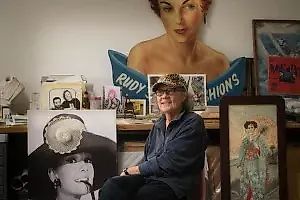
Conceptual artist Alexis Smith, noted for pairing found images with witty texts drawn from sources both classic and profane in collages and installations that examined American identity, especially that of women, died January 2 at her home in Los Angeles. She was seventy-four and had been diagnosed with Alzheimer’s disease in 2015. Her death was announced by her studio manager, Erin Calla Watson. Smith repurposed found objects ranging from silverware to seashells in works that addressed the proliferation of images and the attendant yearning spawned by celebrity culture that characterize much of modern life. Writing inArtforumlast year, on the occasion of Smith’s retrospective at the Museum of Contemporary Art San Diego, Suzanne Hudson described her as “an artist whose body of work acknowledges the desire for escape—from self as much as surroundings—as perfect pretending.”RelatedLA DEALER STEFAN SIMCHOWITZ AIMING FOR DIANNE FEINSTEIN’S SENATE SEATIAN WARDROPPER TO DEPART AS DIRECTOR OF FRICK Alexis Smith was born Patti Anne Smith in 1949, the only child of a young mother afflicted with asthma, who would die when Smith was eleven, and an older psychiatrist father.
Naturally loquacious and a descendent of pioneers, he regaled his daughter with tales of the American West, raising her first on a California citrus grove and then on the grounds of a mental hospital where he worked. The place was “a whole city unto itself,” she toldArt Journal’s Madeleine Grynsztejn in 2014. A self-described tomboy, Smith became a habitual scavenger and collector of junk as a child. She gained an interest in collage around this time, too, clipping photos and combining them with text. At the age of seventeen, after enrolling at the newly established University of California, Irvine, she changed her name to Alexis Smith, after a film star popular in the 1940s and ’50s.
“I would have been known as Patti Smith,” she told Grynsztejn, “so I was just as lucky that I did change it.” At UC Irvine, which then had few buildings and minimal faculty, Smith studied under photographer John Coplans; Vija Celmins, who would become known for her photorealistic drawings of oceans and skies; and installation artist Robert Irwin. Smith would later recall the experience of attending the school as transformative. “It was really just working artists coming in and talking with us,” she told theLos Angeles Times. “It was like sitting under a tree with Socrates.” On her graduation in 1970, she began making artist’s books. “The books were a mish-mash or a mélange of appropriated images and appropriated text,” she told Hunter Drohojowska-Philip in a 2014oral interviewfor the Archives of American Art.
“I had a table that was covered with felt. And I made people wash their hands before. And they sat down. And they got to, one by one, turn the pages and look at the images. And it made a lot of people really uncomfortable.
. . . That was like their little performance, and it kind of creeped them out.” Within a year, she had expanded her oeuvre to include framed collages; installations would follow shortly thereafter. She received her first solo show in 1973, at Riko Mizuno’s Los Angeles gallery.
A spate of other local shows followed and in 1975, curator Barbara Haskell—whom Smith had met the previous year through a women’s group that also included Celmins and Venezualan painter Luchita Hurtado—organized an exhibition for her at the Whitney Museum of American Art. The New York institution would host a retrospective of her work in 1991. Slicing up and juxtaposing the musings of writers from Raymond Chandler to Gertrude Stein to Thomas Mann as well as sharp phrases pulled from advertising, Smith’s works centered the leisure and entertainment culture of the 1980s and the fashion and commerce of the 1990s and early 2000s. “Alexis Smith’s oeuvre slips easily into this American life,” wrote Andrew Berardini in a 2020 issue ofArtforum.“Using language and literature, toys and glamour, ads and junk shop finds, Smith descends from the droll end of West Coast Conceptualism. She turns culture over and pokes at its squirming parts with an air of critical romance and a smile.” “I’m not a social critic,” Smith told Grynsztejn.
“I point out what I think are amusing and ironic human qualities, and I think people, both men and women, generally have a hard time in life.” Among the public works by Smith that remain permanently on view are 1970’sTasteat the Getty Center in Los Angeles; 1992’sSnake Path, a 560-foot-long slate path at the University of California, San Diego’s Stuart Collection; and terrazzo floors at the Los Angeles Convention Center and at Ohio State University’s Schottenstein Sports Arena. She participated in several iterations of the Whitney Biennial and was featured in the 2007 traveling landmark exhibition “Wack! Art and the Feminist Revolution.” Smith’s work is held in the collection of major art institutions including the Los Angeles County Museum of Art; the Museum of Modern Art and the Whitney Museum of American Art, both in New York; and the National Gallery of Art in Washington, DC. “There’s a great Paul Bowles quote that goes, ‘It takes a lot of energy to invest life with meaning,’” she told Grynsztejn. “I think that, in a way, that is how art functions for artists, particularly in what I do, because it is very dependent on chance encounters—the things you find and the opportunities that come your way. I think,” she concluded, “it is a way to make me feel that life is meaningful.”.