Alison Knowles (1933–2025)
70Nov. 4, 2025
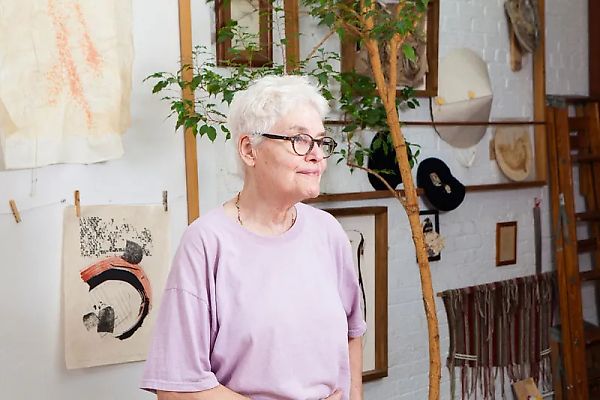
Alison Knowles, a key member of the Fluxus movement whose focus on the haptic set her work apart from that of her compatriots, died at her home in New York on October 29. She was ninety-two. Her death was announced by James Fuentes gallery, which represents her. Working across installation, performance, sound, and poetry, Knowles was best known for her event scores, whose concept was pioneered by Fluxus founder George Brecht, and which consisted of brief instructions for a set of actions. Many of Knowles’s works, such as 1963’sShoes of Your Choice, and 1967’sIdentical Lunch, could be performed at home, or with others. One of her earliest works, 1962’sProposition, offered the reader a simple three-word command:Make a salad. “I think art should take us out of very good times or very bad,” she told Judith Richards in a2010 interviewfor the Smithsonian’s Archives of American Art. “It’s a neutral resting place. It’s a place to take a breath. Art should relieve us and enliven us.”
Alison Knowles was born on April 29, 1933, in Scarsdale, New York. “I remember well when I decided to be an artist,” she told theFluxus Heidelberg Center’s Ruud Janssenin 2006. “It was when my grandmother addressed me as one. She looked at my pencil drawing of an osprey’s nest built in the cross wires of a telephone pole and hung it over the piano. I was six, maybe seven years old.” Beginning her studies at Middlebury College in Vermont, Knowles found she was not attracted to sorority life and transferred to the Pratt Institute in Brooklyn, where her father taught and where she was able to attend night school for free. There she studied under Adolph Gottlieb, Franz Klein, and Richard Lindner. “What I learned there was that I am artist,” she told Janssen. “What I should have learned there was that I am not a painter.” Following an exhibition of her work at New York’s Nonagon Gallery, she collected all her canvases, took them to her brother’s house, and torched them in the backyard.
Through the New York Mycological Society, founded by avant-garde composer John Cage, with whom she became close friends, Knowles fell in with peers George Maciunas, Nam June Paik, Dieter Roth, Emmett Williams, Ben Patterson, Wolf Vostell, and Dick Higgins. (She would marry, divorce, and marry Higgins again; their twin daughters, Jessica Higgins and Hannah Higgins, survive her). Under Maciunas’s leadership, the collective together formed the Fluxus group. She toured Europe with the group, performing at the first Fluxus Festival, in Dussëldorf, in 1962.
Around this time, she began writing her event scores. For the debut ofProposal—also frequently referred to asMake a Salad—at the Institute of Contemporary Arts in London in 1962, she chopped large quantities of vegetables to the beat of live music before an audience, to whom she served the results. The work has since been performed numerous times around the world, publicly and privately.Nivea Cream Piece, 1962, prompts a performer to come to the stage with a bottle bearing the label “Nivea Cream” and to pour a large quantity out and massage their hands with it in front of a microphone. Others enter, one by one, and perform the same action, the group making “a mass of massaging hands” before leaving in reverse order.Shoes of Your Choicecalls for the performer to describe their footwear, whileIdentical Lunchcommands the eating each day of the same meal: “a tunafish sandwich on wheat toast with lettuce and butter, no mayo and a large glass of buttermilk or a cup of soup.” A number of these scores are compiled in the 1965 volumeBy Alison Knowles,published by Something Else Press, which she and Higgins launched in 1963.
Knowles also created sound works, which frequently centered the bean, an uncommon object in the Fluxus oeuvre. Representative of these wasBean Garden, originally staged in 1971, a massive platform carpeted with dry beans, across which visitors were invited to walk, enjoying the crunching sounds of their footsteps. The bean also figured in her book objects, such as theBean Rollsof 1963, produced at the urging of Maciunas and comprising a tin filled with rattling beans and tiny scrolls that when unfurled offered found texts copied from such disparate sources as comic books and advertisements. Her book objects might also take colossal form, as in 1967’sThe Big Book, featuring eight-foot-by-four-foot pages secured to a central spine and moveable via casters. Viewers were invited to enter the book and “turn” the pages, which contained such household necessities as a stove, a toilet, and a bed, as well as a library and artworks.
Knowles wrote her own poetry as well, most famously the computer-generated poemHouse of Dust, 1967, which she created with electronic composer James Tenney. Lists of four qualities that might belong to a house—material out of which the dwelling is made, location, lighting source, and inhabitants—were supplied to a programmer and translated into FORTRAN, with an early version of an IBM computer combining them at random and spitting out hundreds of unique stanzas in quatrain form. One such example read:
A house of discarded clothing
under water
lighted by candles
inhabited by people from all walks of life
“Exploring new media, for me, has always been a collaborative endeavor; it involves working with different people and the diverse materials and means we choose,” she wrote in Artforum in 2012. “Some new-media projects today are missing this collective aspect.”
Knowles was the subject of major exhibitions, including, in the past decade, a 2016 survey at Pittsburgh’s Carnegie Museum of Art, and a retrospective opening in 2022 at the Berkeley Art Museum & Pacific Film Archive in California and traveling to the Museum Wiesbaden, Germany; and to MAMC+ Saint-Étienne Métropole, France, where it will open November 8 before moving on to Nikolaj Kunsthal, Copenhagen, and the Grey Art Museum at New York University next year. Knowles’s works are held in the collections of museums around the world, among them the Getty Research Institute and the Los Angeles County Museum of Art, both in LA; the San Francisco Museum of Modern Art; the Walker Art Center, Minneapolis; the Art Institute of Chicago and the Museum of Contemporary Art Chicago; the Carnegie Museum of Art, Pittsburgh; the Brooklyn Museum, the Metropolitan Museum of Art, the Museum of Modern Art, and the Whitney Museum of American Art, all in New York; the Philadelphia Museum of Art; the Smithsonian American Art Museum, Washington, DC; Tate Modern, London; the Stedelijk Museum, Amsterdam; the Centre Pompidou, Paris; Hamburger Bahnhof, Berlin; Staatsgalerie Stuttgart; and Fondazione Bonotto, Colceresa, Italy.