Pope.L (1955–2023)
254Dec. 29, 2023The names
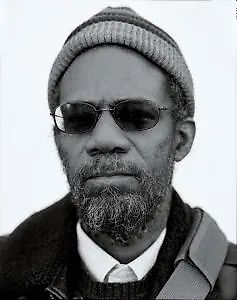
Pathbreaking conceptual and performance artist Pope.L, who explored themes of race, power, and class through interventions that were often fiercely physical, frequently shocking, and almost invariably thought-provoking, died suddenly on December 23 at his home in Chicago. He was sixty-eight. His death was announced on December 27 by the three galleries that represent him: Vielmetter Los Angeles; Mitchell-Innes & Nash, New York; and Modern Art, London. Whether smearing himself with mayonnaise and flour in a storefront window, devouring pages of theWall Street Journalwhile perched atop a toilet, or crawling the length of New York City’s Broadway in a Superman costume, Pope.L interrogated social, political, and economic systems by operating at their margins, where many of those whose concerns he sought to address dwelt. “I am a fisherman of social absurdity, if you will,” he explained.
“My focus is to politicize disenfranchisement, to make it neut, to reinvent what’s beneath us, to remind us where we all come from.”RelatedDIRECTOR OF ISTANBUL BIENNIAL STEPS DOWN AMID CURATOR CONTROVERSYMET RECEIVES MAJOR GIFT FROM DICK WOLF Pope.L was born William Pope in Newark, New Jersey, on June 28, 1955, to a father who soon exited his life and a mother who struggled with addiction. He would later append the initial of his mother’s last name to his own before dropping his first name altogether. Pope.L’s upbringing was peripatetic and unstable, marked by food and housing insecurity. Introduced by his grandmother, with whom he lived for a time, to a portrait painter whose home she cleaned, he gained an early interest in art, eventually enrolling in Brooklyn’s Pratt Institute. Forced by a lack of funds to drop out, he took work in a factory, eventually earning his BA from what is now Montclair State University in New Jersey, and his MFA from Rutgers University.
Pope.L additionally earned a spot in the prestigious Whitney Museum Independent Study Program and studied experimental theater at Mabou Mines. Though his practice embraced photography, painting, sculpture, and writing, Pope.L would become best known for what he called his “crawl” pieces, highly public performances in which he assumed an abject position and crept through gutters, streets, and parks, to the amazement (and sometimes horror) of those he encountered. He performed his first crawl piece in 1978: Clad in a business suit and propelling a potted plant ahead of him, he traversed the length of New York’s Forty-Second Street. Later iterations included 1991’sTompkins Square Crawl, which saw him slither through the gutter of the titular East Village park wearing a business suit and pushing a potted flower. ForThe Great White Way, 2001–2009, he wore a Superman costume sans cape and strapped a skateboard to his back, wheels out.
Over the work’s nine-year span, he incrementally crawled the twenty-two miles of New York’s Broadway from the Battery to his mother’s house in the Bronx. These works, which examined racism, Blackness, and freedom, often aroused intense and diverse emotions in those unexpectedly encountering them, particularly those who might see their identity as bound up with the artist’s: Pope.L recalled nearly being kicked in the face by a Black man during one performance; another crawl brought a Black man, concerned by the sight of a white cameraman filming the seemingly debasing performance, racing to inquire as to Pope.L’s well-being. Pope.L—who on occasion introduced himself as “the friendliest Black artist in America,” and copyrighted this description—often turned to absurdity to make a point. For 1991’sI Get Paid to Rub Mayo on My Body, he appeared in the window of New York’s Franklin Furnace, where he slathered himself with mayonnaise, milk, and flour, among other substances, in a work that investigated the concept of whiteness. For 1997’sATM Piece, created in response to a freshly enacted New York law that made it illegal to panhandle within ten feet of an ATM, he chained himself to the door of a midtown Manhattan Chase Bank with an eight-foot rope of Italian sausages.
Wearing only a pair of Timberland boots and a skirt fashioned from dollar bills, he dispensed cash to passersby.Eating the Wall Street Journal, the first iteration of which Pope.L performed in 1991, saw the artist wash down pages of the financial daily with ketchup and milk, while variously sitting atop an American flag or perched on a toilet, wearing a jockstrap and powdered white with chalk dust. Like the crawl pieces, he re-staged variations of this and other works on numerous occasions. “Versioning is a way of creating incompleteness and ongoingness at the same time,” he told theArt Newspaper’s Margaret Carrigan this past November. “The idea of a finished artwork is a fiction. The claim of ‘being done’ is wishful thinking and a bit impatient.” Later works included “Trinket,” 2015, which commented on the modern state of democracy via a massive American flag on which were trained four industrial fans, whose sustained winds caused the banner’s fabric to fray. For a 2017 show in Detroit titled “Flint Water Crisis,” he presented plastic bottles containing the lead-tainted water that flowed through the taps of the economically blighted Michigan city of Flint after city officials tapped the Flint River for drinking water as a money-saving measure.
Though a sense of nihilism attended these and other works, this was just one nuance among many. “Meaning is important,” he told Carrigan. “Just because I value nothingness or incompleteness or absence does not mean I do not value meaning. It’s just that sometimes meaning, our use of it, can be used to obscure meaning or devalue it. And then there is the obvious,” he concluded.
“As a tool, meaning has its limits.” Concurrent with his career as an artist, Pope.L was an educator, lecturing on theory and rhetoric at Bates College in Lewiston, Maine, from 1990 to 2010 before decamping to Chicago, where he served as faculty in the visual arts department of the University of Chicago for over a decade. He began to achieve his fullest recognition only in the last decade of his life, winning the top prize at the Whitney Biennial in 2017, and receiving a 2019 retrospective that spanned New York’s Museum of Modern Art and Whitney Museum of American Art. A memorial is planned for the coming spring..