Giovanni Anselmo (1934–2023)
231Dec. 21, 2023The names
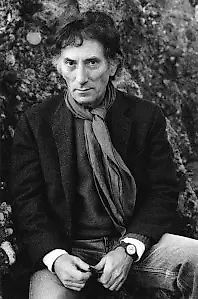
Giovanni Anselmo, a key figure in the radical Italian Arte Povera movement of the 1960s, died in Turin on December 18 at the age of eighty-nine. His death was announced by New York’s Marian Goodman Gallery, which had represented him for nearly forty years. Reacting against the commercialization of art and responding to the economic woes in which Italy was immersed as World War II receded in the rearview mirror, Anselmo, along with compatriots including Enrico Castellani, Giuseppe Penone, Michelangelo Pistoletto, and Gilberto Zorio, placed humble materials such as fabric and concrete in the service of works that challenged the bourgeois values of the day. Anselmo juxtaposed organic and inorganic materials in sculptures that typically embodied energy, manifested in the tension between the elements composing them. These works investigated physical concepts such as gravity and magnetism, as well as metaphysical notions regarding nature, the cosmos, and existence itself. “I, the world, things, life,” he once said, “we are points of energy, and it is not as necessary to crystallize these points as it is to keep them open and alive.”RelatedITALIAN GOVERNMENT BEGINS SIFTING OUT FOREIGN MUSEUM DIRECTORSBRITISH MUSEUM ANNOUNCES BP-FUNDED REFURBISHMENT Giovanni Anselmo was born on August 5, 1934, in Borgofranco d’Ivrea, in northern Italy.
Having trained as an architect, he taught himself painting before eventually turning to sculpture. In 1967, his work was included in a group show curated by Germano Celant at Genoa’s La Bertesca Gallery. The exhibition, the first to focus on Arte Povera, as Celant branded the movement, and additionally featuring works by Alighiero Boetti and Jannis Kounellis, would prove profoundly influential. The following year, Anselmo received his first solo show at Milan’s Galleria Sperone. In 1969, his work was included in the pathbreaking group exhibition “Live In Your Head: When Attitudes Become Form,” curated by Harald Szeemann at Switzerland’s Kunsthalle Bern.
Three years later, Szeemann would invite Anselmo to contribute to the fifth iteration of Documenta, which he was curating. Anselmo would participate in the Kassel quinquennial twice, and showed in several editions of the Venice Biennale, claiming the prestigious Golden Lion at the forty-fourth iteration, in 1990. Anselmo sought, as heexplained, to show “the physicalization of the force of an action, the energy of a situation or event, not the experience of this at the level of annotation or sign or still life only. It is necessary, for example, for the energy of a twist to live with true force; it would certainly not live with its form alone. I think that to work in this direction, since energy exists under the most varied appearances and situations, there is a need for the most absolute freedom of choice or use of materials.” Among the materials Anselmo favored were stone, plants, and metal.
He put all three to use in what is perhaps his best-known work,Untitled (Sculpture That Eats), 1968, comprising a large, smooth rectangular column of granite atop which sits a lettuce, crowned by a smaller block of granite, loosely secured by a wire. Should the lettuce rot or dry sufficiently to shrink, the little block would tumble to a heap of sawdust surrounding the larger caryatid. Some have seen the work as a meditation on time and nature; others have suggested that it comments on the fate of man, at the mercy of larger, crushing forces. ForParticolare, 1972, another widely recognized work, he projected the titular word, which translates to “detail” in English, against a wall or block of granite, exploring issues of labeling and categorizing. His 1984Verso oltremareplaces a large, jagged slab of stone in tension with a fragile-looking rectangle of ultramarine at its peak, the structure anchored to a wall via a straining steel cable, and the entire construction inducing a sense of unease in the viewer.
Anselmo in 2019 was awarded the Presidente della Repubblica at the Accademia Nazionale di San Luca, Italy. His work is held in the collections of institutions including the Art Institute of Chicago; the Museum of Modern Art, New York; the National Gallery of Art, Washington, DC; and the Castello di Rivoli, Turin. A retrospective of his work is set to open at Spain’s Guggenheim Bilbao on February 9; as well, he will be featured in a major Arte Povera survey curated by Carolyn Christov-Bakargiev and opening at the Bourse de Commerce, Paris, later in the year..