Richard Hunt (1935–2023)
257Dec. 19, 2023The names
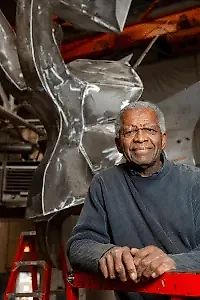
Richard Hunt, a descendant of enslaved people who in the last half of the twentieth century rose to become the world’s preeminent African American abstract sculptor, died on December 16 at his home in Chicago. He was eighty-eight.Newsof his death was confirmed by his studio, and by Jon Ott, his biographer. Frequently working with welded scrap metal, steel, or bronze, Hunt created sculptures that appeared almost weightless despite the heft of the materials from which they were made, evoking ascent, escape, and freedom. His monumental works grace public spaces around the globe; with more than 160 commissions to his name, Hunt was the world’s most prolific sculptor of public art. With many of his works touching on themes of Black history, Hunt, who as a young man was active in the cause of desegregation, through his work sought to put issues surrounding race in the rearview mirror. “Imagining a world without racial hierarchy,” hesaidin 2021, “I work as if race did not exist.”RelatedMET TO RETURN LOOTED TREASURES TO CAMBODIA, THAILANDBRITISH MUSEUM’S DEPUTY DIRECTOR DEPARTS IN WAKE OF THEFT INQUIRY Richard Hunt was born on September 12, 1935, the oldest of two children.
His father was a barber and his mother a city librarian. Having become interested in art at an early age, Hunt began making sculptures from clay, wood, and sculpt-metal in his bedroom in the 1940s. Before long, he set up a studio in the basement of his father’s barbershop, where he was employed, and where he gained an interest in social issues. Following his early high school graduation, Hunt in 1953 enrolled in the School of the Art Institute of Chicago (AIC). Two years later, at the age of nineteen, he attended the funeral of fourteen-year-old Emmett Till, a fellow Black Chicagoan who was kidnapped, tortured, and murdered in Mississippi by white men after being accused of offending a white woman. The event, at which Till’s mutilated body was publicly displayed in accordance with his mother’s desire to bring attention to the killing, had a profound influence on the course of Hunt’s career.
“That really set the tone for his entire artistic life, which was really focused around representing freedom, and freedom in every sense,” Ott told theNew York Times.Hunt shortly thereafter taught himself to weld:Hero’s Head, 1956, depicting Till’s disfigured head, was one of the first welded sculptures he would make. Originally creating work that was more figural than abstract, Hunt began exhibiting publicly while still a student. He quickly garnered acclaim and attention, with New York’s Museum of Modern Art purchasing his 1956 sculptureArachnewhile he was still a junior. Welded from found objects, including an automobile muffler and a pair of lampshades, the work embodied the interest in transformation that characterized his early work. It would appear fifteen years later on the cover of the catalogue accompanying his 1971 retrospective at the New York institution, the first of its kind awarded to an African American sculptor. Following his graduation, Hunt explored Europe on a fellowship; it was there that he began working in bronze.
A two-year draft stint in the army, during which he worked as an illustrator, came next. On his exit from the service, Hunt briefly settled in New York, before returning to Chicago, where he would live for the rest of his life. Having become fascinated with the work of Spanish sculptor Julio González in 1953, when he encountered it the MoMa survey “Sculpture of the Twentieth Century” when it traveled to the AIC, he continued his explorations of open-form sculpture and its attendant voids, scouring streets and junkyards for elements for his constructions. “Hunt’s work, welded sculpture from salvaged materials, is marked by a high degree of professional competency and ambition,” wrote Fidel A. Danieli in the pages ofArtforumin 1965, reviewing a Los Angles show of work by the then twenty-nine-year-old sculptor. “The eye is forced to survey slowly, so controlled and serious are his statements.
Empathy is all. Set are the motifs of linear linkage, a tidy concern for detail and appropriate terminating endings, and his blending of mechanical and organic vocabularies.” In 1968, President Lyndon Baines Johnson appointed Hunt to the National Council on the Arts. In 1971, the year of his MoMA retrospective, Hunt purchased a former electrical substation in Chicago’s Lincoln Park, transforming it into his studio. For decades, he would regularly sleep in the amenity-poor building on a mattress placed on the floor, amid the looming piles of scrap metal with which he worked. Among Hunt’s best known works are the 1958Hero Construction, an abstract human figure welded from pipe auto parts, currently in the collection of the AIC; the gravity-defying 2001Flight Forms, which greets visitors at Chicago’s Midway Airport; the bronzeFlintlock Fantasy,or the Promise of Force, 1991–96, in Detroit; andThe Light of Truth, 2021: Created in recognition of Ida B. Wells, it is Chicago’s first public sculpture honoring a Black woman.
His 15-foot-high stainless steel sculptureHero Ascendingwill be installed adjacent to the Emmett Till/Mamie Till-Mobley historic home in Woodlawn, Illinois, later this year. His sculptureBook Bird, evoking a bird taking wing from the pages of a book and commissioned for the Obama Presidential Center in Chicago, will be on view there once the institution opens in 2025. Hunt’s work is held in the collections of 114 major American arts institutions and is on view at libraries, campuses, parks, and plazas around the world. “I must, I can, I will provide the physical evidence of me and my family having lived upon this earth, this planet,” Hunt said in 2021. “In the great scheme of things it is less than a drop in the bucket but it pleases me to be able to leave this evidence here for a time.”.