Ken Jacobs (1933–2025)
82Oct. 10, 2025
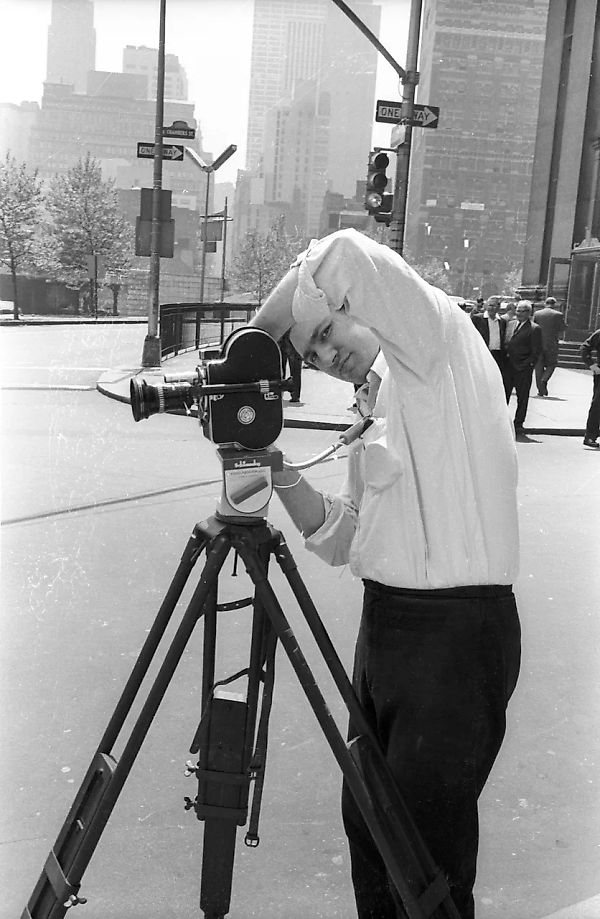
Filmmaker Ken Jacobs, a towering figure in the world of experimental cinema, died of kidney failure on October 5 in New York. He was ninety-two. Alongside peers including Jack Smith and Jonas Mekas, Jacobs pioneered the use of found footage, which he spliced together and manipulated to create highly original and often intense films that crackled with provocative energy. “Jacobs reduces cinema to its essential ingredients, creating ‘film-performances’ that are at once seductive and radically disorienting,” wrote Kristin M. Jones in a 1997 issue ofArtforum. HisStar Spangled to Death, a nearly seven-hour film that took him forty-seven years to make, is considered to be a masterpiece of the genre, as are shorter works, such asLittle Stabs at Happiness,Blonde Venus, andTom, Tom, the Piper’s Son, the last of which represents a pinnacle in the world of avant-garde film.Jacobs was a founding member of the New York Film-Makers’ Co-Operative and, in 1966, the inaugural director of the Millennium Film Workshop, two nonprofit organizations that continue to support avant-garde filmmakers decades after their establishment.
Ken Jacobs was born in Brooklyn on May 25, 1933, to divorced parents. His mother, an artist, died when he was seven, leaving his father, a former minor league baseball player, to raise him. Jacobs graduated from the City University of New York and, following a two-year stint in the Coast Guard, briefly studied painting under Hans Hofmann. A frequent attendee of Cinema 16, which regularly showed avant-garde works, he turned his Modernist-trained eye toward creating what he would describe as “Abstract Expressionist cinema.” His first endeavor, the 1955 shortOrchard Street, offered a fragmented, kaleidoscopic view of the Lower East Side Thoroughfare and its denizens. Jacobs began work onStar Spangled to Deathtwo years later and completed hisfirst film,Little Stabs at Happiness, made as a “breather” from the larger project, in the early 1960s. With a run time of less than fifteen minutes, the film featured Smith in two of its four segments, shown playing with dolls with a female companion in a bathtub in one, and dressed as a clown on the roof of an apartment building in another. Writing in 1967’sAn Introduction to Underground Film, Sheldon Renan described the work as “greatly admired by film-makers, but not by audiences.”
Jacobs’s next endeavor, 1963’sBlonde Cobra, took its title from two of Smith’s favorite films, the 1933 pre-Code Marlene Dietrich vehicleBlonde Venusand the 1944 camp classicCobra Woman. Described by Jacobs as a “look in on an exploding life, on a man of imagination suffering prefashionable Lower East Side deprivation and consumed with American 1950s, ’40s, ’30s disgust,” the film combined footage shot and abandoned by fellow filmmakers Smith and Bob Fleischner, and dealt with such then-taboo themes as cross-dressing, necrophilia, sadism, and suicide.Blonde Cobrapremiered on a midnight double bill with Jack Smith’sFlaming Creaturesat New York’s Bleecker Street Cinema. Mekas, writing in theVillage Voice, characterized it as “a work hardly surpassable in perversity, in richness, in beauty, in sadness, in tragedy.”
Tom, Tom, the Piper’s Son(1969) followed, a nearly two-hour meditation constructed from a single clip of a silent 1905 Billy Bitzer film of the same name, variously slowed down, speeded up, and looped. “There’s already so much film,” he said of the work. “Let’s draw some of it out for a deeper look, toy with it, take it into a new light with inventive and expressive projection. Freud would suggest doing so as a way to look into our minds.” The film entered the National Film Registry in 2007.
Later works includedPerfect Film(1986) andOpening the Nineteenth Century: 1896(1990). In 1999, he began work on a series he called “Eternalisms,” using an editing system he devised himself to render two-dimensional images as three-dimensional when perceived by the naked eye without the use of 3D glasses, regardless of whether the work was presented on a laptop or a theater screen. ForCelestial Subway Lines/Salvaging Noise, a 2005 collaboration with avant-garde composer John Zorn, he incorporated a modified version of a magic lantern, an image projector developed in the seventeenth century.
In 2004, Jacobs completedStar Spangled to Death, which debuted at the New York Film Festival that year and featured clips as disparate as Nixon’s “Checkers” speech, surreal early animated cartoons, and ethnographic footage. Described by J. Hoberman writing in theVillage Voiceas “the ultimate underground movie,” the film offered a revelatory and caustic critique of American society.
Concurrent with much of his filmic career, Jacobs also worked as an educator, teaching in the cinema department of Binghamton University’s Harpur College from 1969 to 2002. During his lifetime, Jacobs was honored with numerous awards, among them the American Film Institute’s Maya Deren Award, a John Simon Guggenheim Fellowship, and grants from the National Endowment for the Arts, the Rockefeller Foundation, and the New York State Council on the Arts. His work has appeared at such international forums as the Berlin Film Festival, the London Film Festival, the Hong Kong Film Festival, the New York Film Festival, and the International Film Festival Rotterdam, as well as institutions including the Museum of the Moving Image, the Museum of Modern Art, and the Whitney Museum of American Art, all in New York.
Jacobs is survived by his son Azazel Jacobs, also a filmmaker, and daughter, artist and musician Nisi Ariana Jacobs. His wife, Flo (Karpf) Jacobs, with whom he collaborated on many of his works, died earlier this summer. Jacobs shed light on both his wife’s importance in his work and his own experience as a renowned filmmaker operating in underground circles in a 2005 article for Millennium Film Journal. “Does everyone understand Flo’s contribution?” he wrote. “Besides all the lifting and hauling and helping feed and keep my contraptions together during performance, recruited to performing, I rely on her taste, her approval, her finer sensibility. In all most all the instances we’ve traveled and presented work together, relieving me of the bleak loneliness of the distant gig, applause followed by return to pimpled teenage outsider gloom.”