Robert Grosvenor (1937–2025)
303Sept. 12, 2025
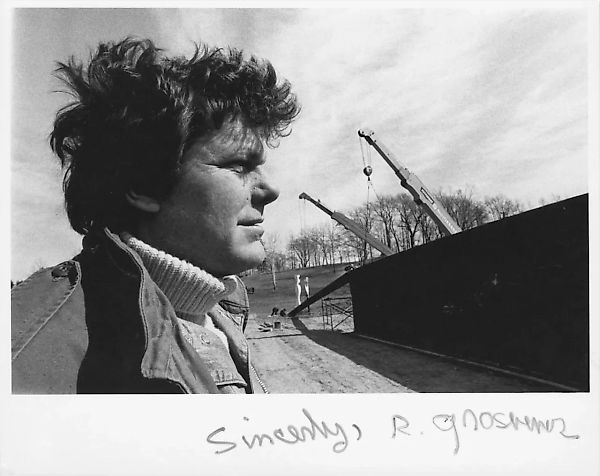
SculptorRobert Grosvenor, whose work refused easy categorization, died in Long Island, New York, on September 3. He was eighty-eight. News of his death was confirmed by Paula Cooper Gallery, which represented him for more than fifty years. Grosvenor over a career spanning six decades created art that investigated the spatial relationship between the viewer, the work, and its surrounds. Unlike many of his peers, he fabricated most of his own sculptures, tailoring them specifically for the spaces in which they were installed and frequently refusing to title them. His output was almost maddeningly diverse, ranging from spare, bright, angular metal structures that appeared to soar, to dark, melted-looking bundles of wood that rested heavily on the floor. His later works, which took cars and speedboats as their themes, were similarly handmade, their forms at once suggesting nostalgia and escape velocity. “I like things I’ve seen very fast and I don’t remember what they are; but I remember the outline, the image,” he toldTimemagazine in 1968. “I’d like my sculptures to be remembered the same way.”
Robert Grosvenor was born March 31, 1937, in New York and raised in Newport, Rhode Island, and Arizona. “They were very sort of flat landscapes, the ocean in Newport, and the desert in Arizona. Which were formative to me,” he told Storm King Art Center’s Sarah Dziedzic in 2018, describing the sight of diminutive Frank Lloyd Wright houses dotting the arid Southwestern landscape as seeming to represent a “fantastic future.” After studying at the Ecole des Beaux-Arts in Paris; the Ecole Supérieure des Arts Décoratifs in Paris; and the Universitá di Perugia in Italy, he returned to the US in 1959 to serve a six-month stint in the army, where he did not see combat but instead fell in with a cohort from downtown New York. On his release from service, he moved there and wound up getting studio space in the same building as sculptor Mark di Suvero, whose work he had admired in a magazine. Through di Suvero, he became connected with the Green Gallery. “It sort of opened things up for me,” he told Dziedzic. “It was an important time.”
Having concentrated earlier on painting, Grosvenor in the early 1960s began experimenting with plywood and two-by-fours, taking his cues from architecture. In 1965, by now working out of a large Broome Street studio one floor beneath James Rosenquist, he created two of his best-known monumental cantilevered sculptures:Topanga, a silver-and-yellow steel-and-wood structure that rose straight out of the floor before peaking and returning to it at an extended angle, andTransoxiana, a steel swoop that appeared to drop from the ceiling before ascending again in a V shape.
The 1970s found him working with large, rough, broken pieces of wood, which he bound together and soaked in acrid-smelling creosote or, later, motor oil, which lent the sculptures a dark, greasily ominous look. His work of the ’80s and ’90s was architectural in nature, with many sculptures seeming to invite entry or occupation. “I think the big shift was in the large Paula Cooper Gallery space, where I was able to separate out elements of the sculptures—put one element in one corner, and another element elsewhere, and maybe a third element somewhere else again,” Grosvenor told theBrooklyn Rail’s Alex Bacon in 2019. “I was able to separate things instead of just having a sculpture be one whole unit.” Grosvenor described such works as “totally impractical,” and indeed, the showing of many of his works is complicated by their being purpose-built for their original display spaces.
The 2000s brought works centered around cars and boats, subjects of lifelong fascination for Grosvenor. “The artist’s new sculptures have a way of insinuating themselves into the viewer’s imagination,” wrote Joseph Masheck in an issue ofArtforumearlier this year. “It’s curious to see how a practical thing can retain its identity while also becoming a full-fledged work of art. Grosvenor’s acts of aesthetic consubstantiation elicit a hankering for the past but are wrapped in an unmistakably vanguard sensibility.”
Grosvenor exhibited widely, participating in such early landmark Minimalist exhibitions as “Primary Structures” at the Jewish Museum, New York, in 1966, and “Minimal Art” at the Gemeentemuseum, The Hague, in 1968, as well as the 1968, 1973, and 2010 iterations of the Whitney Biennial; the 1977 and 1987 editions of Documenta; the 2003 Biennale d’art contemporain de Lyon and the Fifty-Ninth Venice Biennale in 2022. His works are held in the collections of major museums around the world, including the Walker Art Center, Minneapolis; Storm King Art Center, New York; the Museum of Modern Art and the Whitney Museum of American Art, both in New York; the Hirshhorn Museum and Sculpture Garden, Washington, DC.; Serralves Museum, Porto, Portugal; and the Centre Pompidou, Paris. Asurvey of his work—his first solo institutional show in Germany—opened just days before he died, at the Fridericianum in Kassel, where it is on view through January 11, 2026.