Rosalyn Drexler (1926–2025)
199Sept. 9, 2025
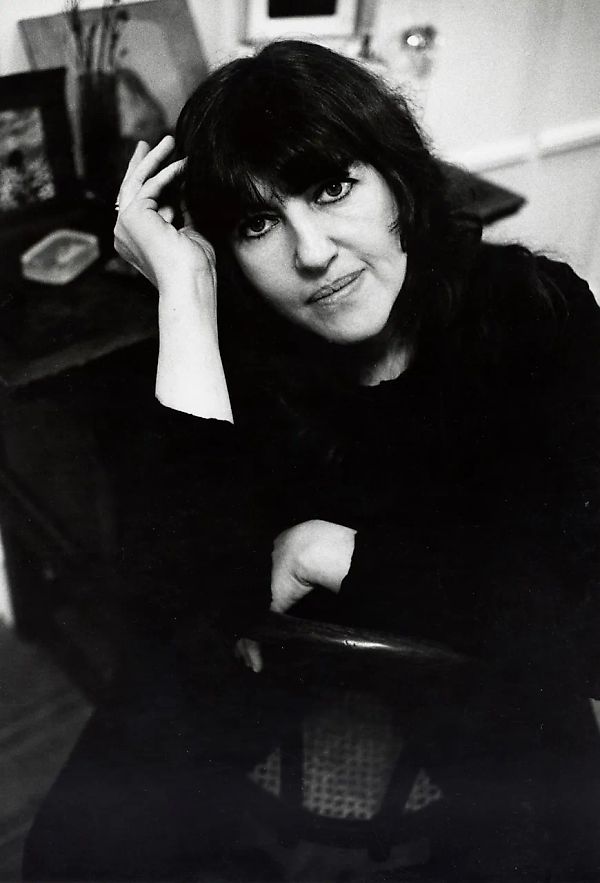
Pop artist Rosalyn Drexler, who interspersed her decades-long career with stints as a masseuse, a house cleaner, and a professional wrestler before finally receiving the acclaim her electric portraits of activated figures against evacuated backgrounds deserved, died at home in New York on September 3. She was ninety-eight. Her death was announced by New York’s Garth Greenan Gallery, which represented her. Working at the same time as such artists as Roy Lichtenstein, James Rosenquist, and Andy Warhol, who would go on to make her his subject, Drexler painted stark scenes in flat, bright hues, her canvases vibrating with violence, its promise, or its aftermath. An accomplished writer, she won three Obie Awards and an Emmy, her written work hot, intense, and boiling with emotion. “I would find the same theme in my writing and my painting: the human dilemma,” she wasquoted as sayingin 2016. “Hit or be hit.”
Rosalyn Drexler was born Rosalyn Bronznick on November 25, 1926, in the Bronx, the oldest of three daughters whose parents were of Russian Jewish descent. Her father took her to the museum; her mother bought her reproduction posters, books, and art supplies. Her attraction to coloring books presaged her minimal style. “Most kids wanted to color outside of the lines, but I loved staying in the lines, because that way I felt protected,” Drexler told theBrooklyn Rail’s John Yau in 2007. “That was my only training.”
Initially drawn to the performing arts, she studied voice in high school and enrolled in Hunter College, dropping out after a single semester to marry figurative artist Sherman Drexler at the age of nineteen. Following a brief three-month tour wrestling as Rosa Carlo, the Mexican Spitfire, at the suggestion of some friends she’d met at the gym, she moved to Berkeley, California, with her new husband, where she began making sculpture from found objects.
The couple returned to New York in the early 1950s and Drexler, whose social circle by then included Elaine and Willem de Kooning and Franz Kline, continued making sculpture. Forced by the closure of her gallery to reconsider her practice, she turned to painting, embracing a method which involved blowing up found images, affixing them to canvas, and slathering them with vividly hued pigment. Early works, such asLost Match, 1962, andTake Down, 1963, took up the theme of wrestling, while the aura of brutality hovered like a fog over works such the iconicMarilyn Pursued by Death, 1963, as well as later works such as the chillingAna Falling (Was She Pushed?), 1989, showing a bikini-clad woman in free fall—presumably painter Ana Mendieta, who plummeted to her death from a high-rise window after an argument with her artist husband Carl Andre. Love and sex were also themes, though an unease lurked here too, as inRomance (Emilio Cruz Could Be Tender), 1991, in which a bright blue lothario-cum-creep kisses a green woman’s shoulder, his discombobulated pupils fixed in a terrifying thousand-yard stare.
Concurrent with Drexler’s painting career was her writing career. Publishing her first play,Home Movies, in 1963 and her first book,I Am the Beautiful Stranger, in 1965, she was prolific in this field, authoring ten plays, nine novels, and four screenplay novelizations, including that ofRocky, which she penned under the pseudonym Julia Sorel. A 1973 television screenplay for Lily Tomlin, cowritten with Richard Pryor, earned her an Emmy. Her 1972 novelSmithereens, about the art world and women’s wrestling, was rereleased earlier this year to critical acclaim.
Drexler finally began receiving her due in the past decade, beginning with the retrospective “Rosalyn Drexler: Who Does She Think She Is?,” which originated in 2016 at the Rose Art Museum at Brandeis University in Waltham, Massachusetts, before traveling to the Albright-Knox Art Gallery in Buffalo and the Mildred Lane Kemper Art Museum in Saint Louis.
“I don’t think my paintings were seen much back in the 1960s. It was the time for Abstract Expressionism and Minimalism; Pop was just beginning to rear its huge, glittering head,” Drexler told Artforum’s Prudence Peiffer in 2016. “My work was a secret kind of thing. I was very close to the Abstract Expressionists . . . but no one realized I was a painter because I was writing about painting. I was happy being productive and having good friends and being ignored. But now I’m getting angry about it, looking back!”
Drexler’s work is held in the collections of major art institutions including the Walker Art Center, Minneapolis; the Albright-Knox Art Gallery, Buffalo; the Museum of Modern Art and the Whitney Museum of American Art, both in New York; the Wadsworth Atheneum, Hartford, Connecticut; the Rose Art Museum, Brandeis University, Waltham, Massachusetts; and the Hirshhorn Museum and Sculpture Garden and the Smithsonian Institution, both in Washington, DC.