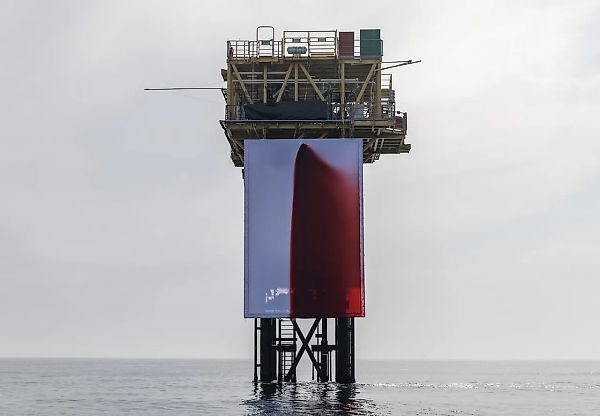
Last Wednesday, Greenpeace activists scaled a gas rig in the North Sea, unfurled a 315-square-foot canvas across its side, and sprayed crimson paint over it. The act was a piece of protest art designed by Anish Kapoor.Titled Butchered, it has been described as the first work of fine art ever exhibited from a working gas rig and is meant as a commentary on “the butchering of our environment,” the British artist told the Guardian.The rig is operated by oil and gas giant Shell, which recently halved its low-carbon renewable and energy solutions investment target for 2030 to 10 percent.“It is at the simplest level blood on a canvas,” Kapoor said. “A reference to the destruction—the bleeding—of our globe and state of being.”The activists were forced to wait for calm seas so they could sail to the rig 45 nautical miles off the coast of Norfolk on a vessel called Arctic Sunrise. They then scaled the rig and hoisted a 25 by 40-foot truss on to the side of the towering metal structure before stretching the massive canvas across it. A high-pressure hose was used to spray a blood-red stain down it. Greenpeace said the paint was made from a mix of seawater, beetroot powder, and non-toxic, food-based pond dye.The campaign group said Butchered was intended to highlight “the vast suffering extreme weather is causing.” It was erected during the UK’s fourth heat wave of the summer so far.“There seems to be, first of all, a collective will to not look at who are the real perpetrators of global warming,” Kapoor said, adding that he wanted the work to dispel “collective amnesia around the real causes of climate breakdown.” Related Articles Anish Kapoor Lists New York Apartment for $17.75 M. Paris's Musée d'Art Moderne to Receive 180 Artworks from French Gallerist Kamel Mennour This is not the first time Greenpeace has taken action on fossil fuel extraction sites at sea. In 2024, Shell agreed to settle a multimillion-dollar lawsuit against the organization, after protestors occupied a moving oil platform off the coast of the Canary Islands for almost two weeks the year before.Last Wednesday’s successful attempt to erect the artwork was Greenpeace’s second, after its first try failed last year. “Safety at sea is our priority. Greenpeace entered a restricted safety zone around the platform without permission, which is established under UK law to protect people and prevent collisions, a Shell spokesperson said. “Their actions were extremely dangerous, involved illegally trespassing and put their own and others’ lives at risk. We respect the right of individuals and organizations to protest, but it must be done safely and lawfully.”Kapoor said that “it’s tragic that governments all over the world are forbidding protests—not just forbidding it, actually arresting people. What’s wrong with us? this is our right and duty as citizens to protest and keep our consciousness alive.”