Developers Cover Rediscovered Wojnarowicz Mural with Drywall
182Aug. 16, 2025
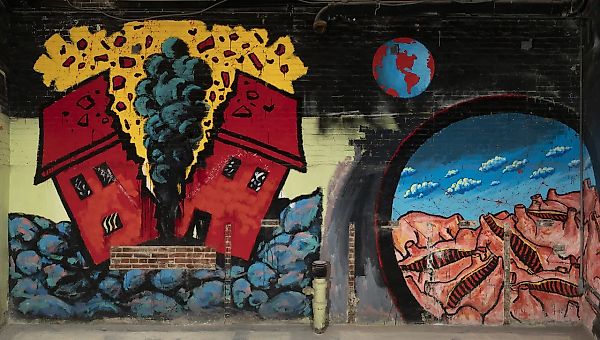
A 1985 mural by David Wojnarowicz that had languished for decades behind a stud wall in a Louisville, Kentucky, building, was uncovered only to be hidden again by developers who leased the space out for use as a gym. Wojnarowicz painted the work, featuring eviscerated cow carcasses, a bright yellow skeleton, a flaming chair, and a split, burning house spewing black smoke from its center directly on the interior of a load-bearing structural wall of the former Kentucky Lithography Company as part of a benefit exhibition in aid of missing children. The show was organized by artist and gallerist Potter Coe after a twelve-year-old girl disappeared from a local mall.
When the building was converted to residences in 1986, workers framed a sheetrock wall in front of the mural, effectively preserving it for the next four decades. In 2023, as the building’s new owner, real estate development firm Zyyo, was making alterations to the structures, Wojnarowicz’s vivid forms were exposed once more. Architect Moseley Putney, who had attended the exhibition for which the mural was painted, was working for Zyyo at the time and notified another artist who’d participated in the show, Judy Glantzman. Glantzman contacted the newly established David Wojnarowicz Foundation, which notified Zyyo and urged it to make the mural accessible to the public.
That same year, New York’s P.P.O.W gallery, which represents the artist, wrote Zyyo to let the developer know it was required to preserve the mural at least until 2042, in accordance with the 1990 Visual Artists Rights Act. Despite these entreaties, Zyyo covered the mural with sheetrock. “We . . . want to respect the foundation’s wishes of protecting the mural, which is what we did,” the developer’s chief creative director, Jamie Campisano, told Hyperallergic.
“If we could have given the mural to them on day one, we would have done that in a heartbeat but it is on a structural wall, so there was no way for us to hand it over. It does not go with the aesthetic or the design for the gym, so we were in a bad place,” Campisano told Artnet News. “Having a mural of this nature just didn’t go with the health and fitness vibe.”