Daniel Muzyczuk to Lead Poland’s Muzeum Sztuki
160Aug. 13, 2025
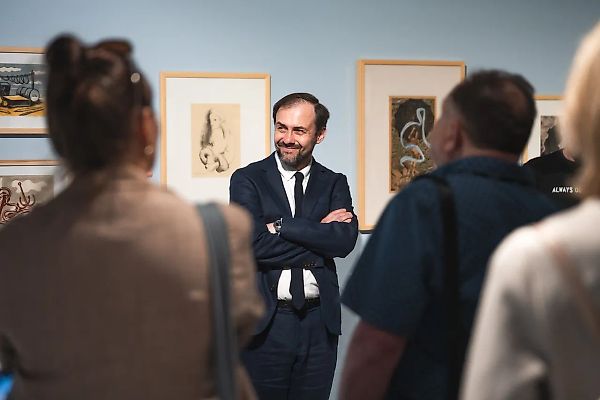
The Ministry of Culture and National Heritage of the Republic of Poland has namedDaniel Muzyczukas the next director of theMuzeum Sztukiin Łódź. Muzyczuk, who was appointed acting director in July 2024 after painter Andrzej Biernacki departed the role, was unanimously recommended to the post by a selection committee.
Muzyczuk arrived to Muzeum Sztuki in 2011, becoming chief curator there in 2015. Among the exhibitions he has helped to organize at the institution are “The Museum of Rhythm” (with Natasha Ginwala, 2016) and “Notes from the Underground: Eastern European Alternative Art and Music Scene 1968–1994” (with David Crowley, 2016), according toArtReview.In 2013, he cocurated the Polish pavilion of the Fifty-Fifth Venice Biennale alongside Agnieszka Pindera. Previously, from 2008 to 2011, he was a curator at the Centre of Contemporary Art Znaki Czasu in Toruń, Poland. Muzyczuk is a member of the Budapest Group, a collective of artists and curators.
Established in 1930, the Muzeum Sztuki is one of the world’s oldest museums of modern art. Like other arts institutions across Poland, it has in recent years seen abrupt leadership changes instituted by Poland’s right-wing government. The appointment in 2022 of Biernacki, a painter in the mode of Francis Bacon and the operator of a small-town gallery, who promised to shift the museum toward locally produced art and away from the international avant-garde work championed by Jarosław Suchan, whom he replaced, was met with outrage by many in the Polish arts community. Małgorzata Ludwisiak, a onetime deputy director of the institution, scathingly remarked at the time, “The change from a highly competent world-class specialist who made Muzeum Sztuki the second MoMA into a man who runs a private gallery in Łowicz is hardly rational.”
Muzyczuk has promised to reaffirm the Muzeum Sztuki’s role as a site of critical engagement and experimentation, building on the legacy of the Polish avant-garde a.r. group artists and their international counterparts. He also plans on expanding the museum physically, creating new storage and exhibition space. “We must understand the museum as both a public institution and an artistic instrument,” he said in a statement, “a space where critical reflection and radical imagination converge.”