Joel Shapiro (1941–2025)
167June 19, 2025
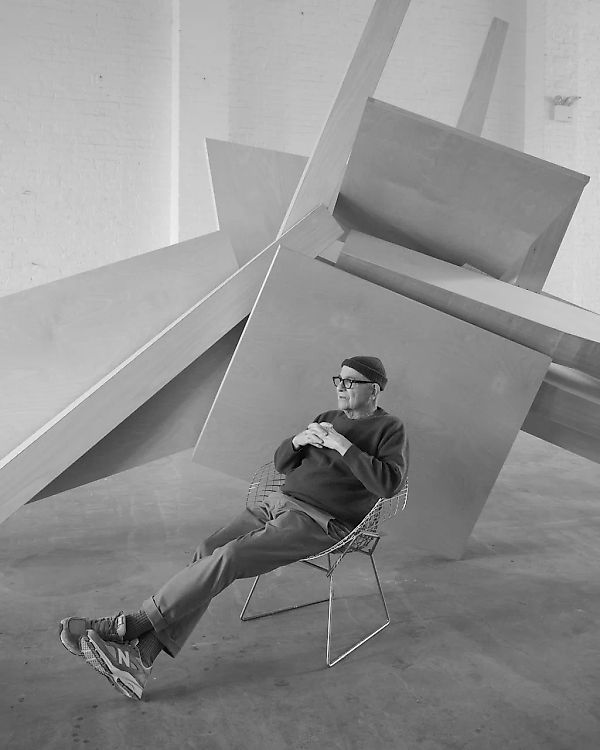
Minimal artist Joel Shapiro, whose colossal stick-figure sculptures surprised with their emotional charge, died on June 14 in a Manhattan hospital. He was eighty-three. His daughter, Ivy Shapiro, told theWashington Postthat the cause of death was acute myeloid leukemia. Shapiro over a career spanning six decades explored figuration and abstraction, reshaping the contours of their overlap. In works large and small, he took art off the plinth and onto the floor or outdoors, reminding viewers of its rightful and integral presence in the world and in their lives. “I was always trying to find a physical manifestation of thought in material and form,” Shapiro toldBomb’s Michèle Gerber Klein in 2009.
Joel Shapiro was born in Queens on September 27, 1941, the youngest child of a physician father and a microbiologist mother who dabbled in sculpture. He frequently accompanied his father on trips to the Metropolitan Museum of Art, where he was especially taken with the displays of armor and mummies. Under familial pressure to become a doctor, he flunked out of the University of Colorado, Boulder, before obtaining a degree in biology from New York University. A two-year stint teaching with the Peace Corps in India followed, after which he returned to NYU, this time earning a master’s degree in art, having been inspired by the melding of art and culture he encountered in the South Asian country.
The New York art scene at the time was dominated by Minimalists such as Sol LeWitt and Donald Judd, whose sleek, stark forms bore no trace of their making. Shapiro in his 1969 workFingerprint Drawingpushed back against what he saw as his compatriots’ resistance to the human touch, coating a fingertip in ink and pressing repeatedly on a large sheet of paper to create a crowded, uneven field of fingerprints that seemed to seethe with life.
Life and dynamism were major themes for Shapiro, whose massive, blocky kinetic sculptures variously conjured human figures dancing, striding, tumbling, and jumping. Even the form in his 1993Loss and Regeneration, commissioned for the plaza of the United States Holocaust Memorial in Washington, DC, appears to evoke joy, despite its black hue, its crumpled position, and its proximity to the work’s other component, a small upturned house conjuring the families slaughtered by the Nazis in World War II. Many of Shapiro’s stick figures, typically of wood or bronze, were brightly colored, further suggesting delight, as embodied for example by his electric-hued 2019 sculptureBlue, a humanoid form captured mid-kick outside Washington’s Kennedy Center.
In addition to his monumental works—including those mentioned above, the artist completed roughly thirty public commissions for venues around the world—Shapiro was known for his miniatures: dense, freighted bronze or iron sculptures of chairs, horses, and houses just inches high, often appearing on floors or shelves. Shapiro created many of these in the early part of his career, responding to the then-current craze for huge abstract pieces with tiny figurative forms. “When I made that small chair there was no need for it to be large,” he told Lewis Kachur in a1988 oral history interviewfor the Smithsonian Institution’s Archives of American Art. “I saw it as a sort of personal artifact. In a way it really dealt with the memory of an experience, but I think it did more than that. . . . I think really it was about insisting upon myself in public.” Shapiro also composed abstract works on paper, in charcoal and chalk, frequently depicting squares. A number of these works were included in a midcareer retrospective at the Whitney Museum of American Art in 1982.
In recent decades, the beams and blocks that made up his human-like forms appeared in more jumbled configurations or untethered from one another, as for example inUntitled, 2012–14, a group of ten vividly hued beams. Writing on their appearance at New York’s Paula Cooper Gallery in a 2014 issue ofArtforum,Donald Kuspit marveled at the way in which the beams, suspended in space, engaged viewers as they moved around the work. “Metaphorically speaking, the beams are passing moments in an endlessly expanding cosmos, spurious presents in the vastness of space-time,” wrote Kuspit. “Their colorful immediacy makes them seem autonomous even as their interdependence shows that they are details of an incomprehensible and incomplete whole.”
Shapiro enjoyed a number of institutional solo shows during his lifetime, including those at Whitechapel Gallery, London (1980); the Whitney (1982); the Stedelijk Museum, Amsterdam (1985); the Walker Art Center, Minneapolis (1995–96); the Museum Ludwig, Cologne (2011); and the Nasher Sculpture Center, Dallas (2016). His work is held in the collections of numerous international museums, among them the Met, the Museum of Modern Art, and the Whitney, all in New York; Tate Gallery, London; and the Centre Pompidou, Paris.
“I’m still improving,” he told The Forward’s Laurie Gwen Shapiro last year. “Working keeps me going. As long as I don’t get Alzheimer’s, I’ve got plenty of work left in me. The joining together, the arranging, the language of sculpture, how it transcends cultures. All that still thrills me every day. What I am still aiming for,” he finished, “is work you cannot refute.”