P. Adams Sitney (1944–2025)
140June 17, 2025
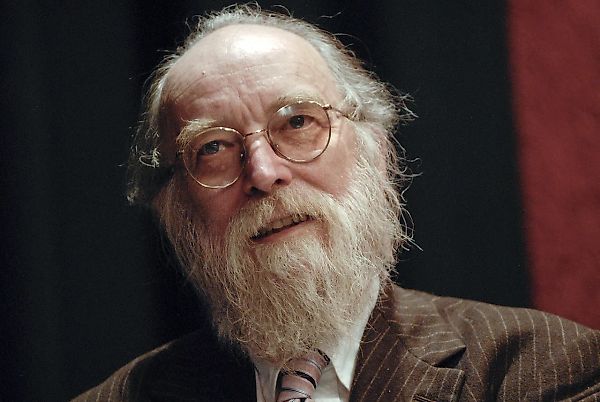
Renowned avant-garde film historianP. Adams Sitney, whose 1974 landmark volumeVisionary Filmremains a canonical work of experimental cinema history, died June 8 at his home in Rhode Island following a brief bout with advanced metastatic cancer. He was eighty. A cofounder of New York’s Anthology Film Archives, Sitney coined the term “structuralism” to identify the minimalist, formalist experimental film that arose in the 1960s, writing extensively about the form in a manner that was as clear and straightforward as his stated disdain for prestigious prizes, the spread of suburbanization, and the penchants of universities for turning poetry into homework. “In a field dominated by academic pedants, Sitney is a rarity,” wrote Brian L. Frye in a 2005 interview with the historian for theBrooklyn Rail. “An art critic of the old school, cheerfully dismissive of scholarly fads and preoccupations.”
P. Adams Sitney was born on August 9, 1944, in New Haven. At the age of fourteen, he wandered into a theater in which Luis Buñuel and Salvador Dalí’s 1929 filmUn chien andalouwas playing and “was hooked” he told Frye. While still a teen, he assembled a film society at the local YMCA and launched the newsletterFilmwise, in which he analyzed the work of such avant-garde filmmakers as Maya Deren and Marie Menken. Sitney earned both a BA in classics and a Ph.D. in comparative literature from Yale, his tenure as a student interrupted by a year spent in Europe lecturing on avant-garde cinema after a professor convinced the draft board he’d be more useful in that capacity than fighting in the Vietnam War, which was then at its height. “I went with a draft-deferment for ‘Services Essential to the Nation,’ which was hilarious, because I was showing [Jack Smith’s]Flaming Creaturesand [Kenneth Anger’s]Scorpio Risingand Andy Warhol’s films,” he told theNassau Literary Reviewin 2015. “They just wanted to get rid of me.”
In 1970, alongside filmmakers Stan Brakhage, Jerome Hill, Peter Kubelka, and Jonas Mekas, Sitney established Anthology Film Archives on what was then New York’s Lower East Side (the neighborhood is today known as the East Village). Sitney served on the film center’sEssential Cinemafilm selection committee, which additionally comprised Kubelka, Mekas, James Broughton, and Ken Kelman and was tasked with determining which films were foundational to American cinema. Though the committee ended its mission with Hill’s death in 1973, the film center endures today as a beacon of both historical and contemporary experimental cinema, and the roughly 330 titles named as essential continue to spark conversation around their notable inclusions and exclusions.
When it appeared in 1974, Sitney’sVisionary Filmwas the first history of American experimental film since World War II to be published in the United States. In it, Sitney broke down avant-garde film into genres, including, most notably, structuralist film, which he described as characterized by a fixed camera position, the use of flicker effect, re-photography off the screen, and loop printing. Other books by Sitney includeModernist Montage: The Obscurity of Vision in Cinema and Literature(1990),Vital Crises in Italian Cinema: Iconography, Stylistics, Politics(1995),Eyes Upside Down: Visionary Filmmakers and the Heritage of Emerson (2008),andThe Cinema of Poetry(2015).
Sitney was also a prolific editor, his efforts in this department including the journalFilm Culture,The Essential Cinema: Essays on the Films in the Collection of Anthology Film Archives(1975), andAvant-Garde Film: A Reader of Theory and Criticism(1978). He contributed criticism to numerous publications, includingArtforum, for whom he wrote about the work of filmmakers includingKen Jacobs,Jean-Marie Straub and Danièle Huillet, andMichael Snow. Perhaps most memorable among his writings for the magazine is his series,begun in 2004, on the sporadic showings of portions of Gregory J. Markopoulos’s eighty-hour film cycleEniaios(1947–91) at the Temenos, an open-air cinema in a field in Lyssarea, Greece, the only venue in which Markopoulos would permit the work to be shown. After a donor’s gift allowed the pace of the screenings to increase from once every four years to once every two years, Sitney became eagerly anticipatory.
“I have attended them all from the beginning, fully expecting to die without having seen the end ofEniaios,” hewrote in a 2024 issue ofArtforum.“Were it not for the benefactor, I would have been over ninety when the film cycle ended. At eighty, I have a reasonable hope of seeing completed the most profound cinematic experience of my lifetime.” The last order of the film is to be shown in 2026.
Concurrent with his writing and editing career, Sitney taught at schools including the Art Institute of Chicago, Bard College, New York University, and Cooper Union. After earning his Ph.D., he began teaching at Princeton, where he was professor of visual arts for decades, resolutely projecting celluloid film even after many of even the most obscure avant-garde films had been digitized. He retired in 2015 having influenced generations of students. Despite—or perhaps in part because of—his contempt for accolades, Sitney received the Logos-Siegfried Kracauer Award for critical writing from Anthology Film Archives in 2008, the President’s Award for Distinguished Teaching in 2010, and the Anna-Maria Kellen Berlin Prize from the American Academy in Berlin in 2011. As well, he was admitted to the American Academy of Arts and Sciences.
“Like the beautiful and challenging films he teaches,” wrote one undergraduate alumnus in nominating Sitney for the President’s Award for Distinguished Teaching, “he has a cult following.”