Ei Arakawa-Nash to Represent Japan at 2026 Venice Biennale
177April 24, 2025
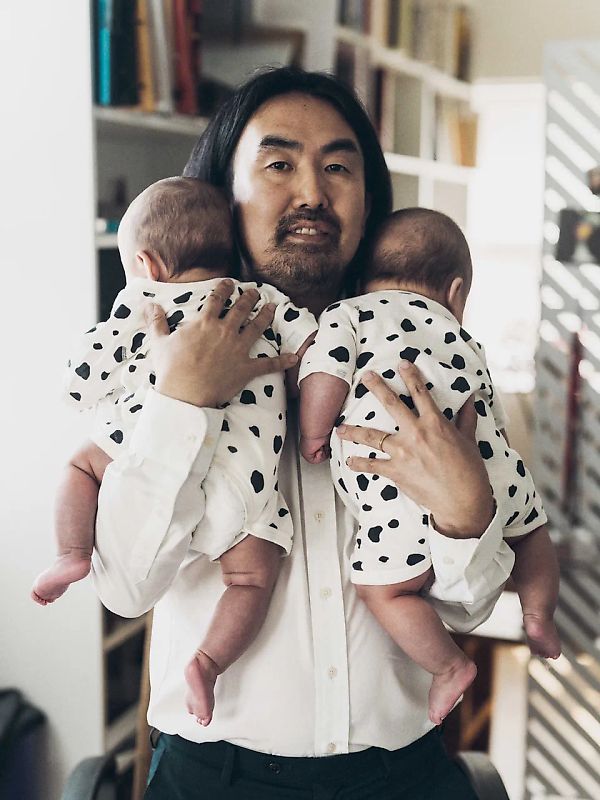
The Japan Foundation has appointed queer Los Angeles–based performance artist Ei Arakawa-Nash to represent Japan at the Sixty-FirstVenice Biennale, to take place May 9–November 22, 2026. Arakawa-Nash, who with his husband parents newborn twins, has said he plans to develop an installation examining themes of nationalism and patriarchy. The installation will draw from his perspective as a queer parent and from the 1962 filmBeing Two Isn’t Easy,whose script, by Natto Wada, will additionally serve as a touchstone.
Arakawa-Nash was born in Fukushima, Japan, in 1977 and from 1998 to 2019 lived and worked in New York before moving to LA, where he is professor in the graduate art program at ArtCenter College of Design in Pasadena, California. Having worked to advance performance art internationally since the early 2000s, he seeks to erase the boundary between audience and performer and to destabilize the subjective “I” in his practice, which often appears improvised and frequently involves collaboration. Among his influences are Gutai, Tokyo Fluxus, Happenings, Judson Dance Theater, and Viennese Actionism. Arakawa-Nash’s participatory installationMega Please Draw Freelywas presented at Turbine Hall, Tate Modern, London, in 2021, and will be on view for six months beginning this July at Haus der Kunst, Munich, as part of the exhibition “For Children. Art Stories Since 1968.” Earlier solo exhibitions include “Paintings Are Popstars,” at the National Art Center, Tokyo, in 2024; “Don’t Give Up” at Switzerland’s Kunsthalle Friart Fribourg in 2023; and “Social Muscle Rehab” at Artists Space, New York, in 2021. Arakawa-Nash participated in the 2019 Honolulu Biennial, the 2017 Skulptur Projekte Münster, the 2016 Berlin Biennale, and the 2014 iterations of the Gwangju Biennial and Whitney Biennial.
“I thought I would never have a chance to represent Japan at the Venice Biennale after I gave up my Japanese nationality a few years ago,” said the artist in a statement. “I am excited about this opportunity to converse with historical performances at the Biennale, such as [Yayoi] Kusama’s guerrilla performance in 1966 or the space Rei Naito presented in 1997.” Noting that the model for the Japan pavilion’s selection process has shifted since the Covid-19 crisis, with the artist now tasked with fundraising and choosing a curator, Arakawa-Nash cited the possibilities inherent in the change. “This means the artist has more agency to turn their ideas into a show,” he said. “Like Dumb Type and Yuko Mohri, the previous artists, I want to bring something new and open in terms of the administration and history of exhibition-making at the Japan pavilion.”