Fred Eversley (1941–2025)
143March 25, 2025
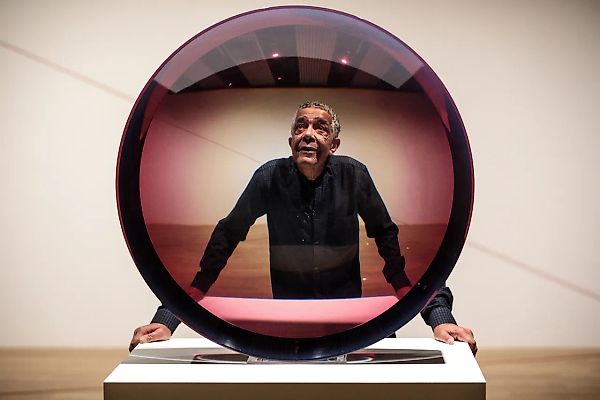
SculptorFred Eversley, who for fifty years made the parabola his subject in pellucid, jewel-toned resin works, died on March 14 following a short illness. He was eighty-three. His death was confirmed toArtnews, which first reported it, by David Kordansky Gallery, which represents him. A onetime engineer tasked with designing labs for NASA, Eversley in the 1960s was a key player in the West Coast Light and Space movement alongside Larry Bell, Robert Irwin, and James Turrell. Unlike his compatriots, Eversley brought science and metaphysics to bear in his explorations of light, routinely applying centripetal force to create sleek, luminous works whose transparent forms radiate a crystalline energy that can seem cool and warm at the same time. “My commitment and focus over all these years stems from my belief that energy is the source of everything in the world,” Eversley toldArtforumin 2022. “Nothing exists without energy. It’s the most essential concept for the basis of all life. So I just tried to push that idea as far as I can.”
Fred Eversley was born in Brooklyn in 1941, the oldest of four children. His father was a civil engineer at an aviation company, and his mother was a schoolteacher and a PTA leader. His curiosity piqued by reading about the experiences of Isaac Newton, Eversley at the age of fourteen filled a pie pan with Jell-O and set it spinning on the family’s turntable, causing a light-reflecting concave parabola to appear in the quivering substance. The form galvanized him. “The parabola is the perfect concentrator of all energy to a single focal point,” he told theNew York Timesin 2022. “I’m all about universality.”
On graduating from Brooklyn Technical High School, he attended the Carnegie Institute of Technology (now Carnegie Mellon University), in Pittsburgh, where he was the only Black student in the electrical engineering program. After obtaining his degree, he accepted a job with Wyle Laboratories, helping to design high-intensity acoustic labs for NASA’s Apollo and Gemini missions, moving to Venice, California, for the role in 1964. There, he fell in with the vibrant artistic community that was then burgeoning in Southern California, talking art theory with Turrell, helping Bell with his vacuum chambers, and offering Charles Mattox technical advice on some kinetic sculptures. “I was lucky I found Venice,” he told theWall Street Journalin 2019. “Without this community, I probably never would have become an artist.”
In 1967,attempting to push-start his carafter a late night at work, Eversley careened down a gully and nearly died. While recovering from his injuries, which limited his mobility and temporarily curtailed his ability to return to work, he began experimenting with tools and materials in Mattox’s studio, casting his first dyed polyester resin pieces. Shortly thereafter, he permanently relinquished his role at Wyle to focus on his art, which frequently took the form of his favorite shape, rendered using a potter’s kick-wheel, onto which he would pour pigmented liquid resin before spinning it and shaping it using a mold, and finally polishing it. Though guided by science, the process was not eminently controllable.
“Even though you might use the same three colors in five different pieces, if you change the speed of each one, they lay over each other and make different pieces,” he told theTimes. “You try to predict, but in the end you get surprises.”
In 1969, Eversley moved into the studio of his mentor, John Altoon, after the older artist’s untimely death. The following year, while visiting New York, he showed his sculptures to Marcia Tucker, then a curator at the Whitney Museum of American Art. Tucker, whom he’d known since the pair worked together as teens at a music store in Greenwich Village, gave him a solo show andpurchased a workfor the Whitney. A flurry of one-man exhibitions across the country followed, and Eversley’s artistic career was launched.
While his early work largely featured red, violet, and amber hues, in 1972, he began creating rich black sculptures, initially in response to a joke from artist John McCracken, who gave him a can of black pigment, admonishing him, “You’re being heavily criticized for not making black art. Make some black art.” The opacity of the resulting works added yet another dimension to Eversley’s practice. “It’s totally different because it’s no longer transparent,” Eversley explained. “Now you’re dealing with a mirror, with some translucency in the center, but basically a mirror.” White and gray works followed; many of these inscrutable sculptures would later appear in the 2017 exhibition “Fred Eversley: Black, White, Gray” at the Rose Art Museum at Brandeis University, where, per the artist, they conjured “stars expanding their energy and becoming black holes, white dwarfs, and neutron stars.”
Eversley in 1977 was named the inaugural artist in residence at the Smithsonian’s National Air and Space Museum. His thirty-six-foot-high Parabolic Flight, 1980, constructed of stainless steel and neon, occupies the grounds of the Miami International Airport, while two recent public commissions, Parabolic Light, 2023–24, and Portals, 2024, respectively grace New York’s Central Park and West Palm Beach, Florida’s Julian Abele Park.
Despite the overwhelming and constant critical acclaim his work achieved, Eversley’s career was marked by racism, with the artist only gaining gallery representation, with Kordansky, in 2018. Forced out of his longtime Venice studio by a gentrifying landlord in 2019, Eversley moved to New York, where he and his wife, artist Maria Larsson, who survives him, had bought a five-story cast iron building on SoHo’s Mercer Street back in 1980. Here, he began making his “Cylindrical Lenses” series. Begun after 2020, the series is characterized by monumental, freestanding polyurethane shapes of up to nine feet in height, vividly hued at the base, the color seeming to drain away as the eye travels up to finally apprehend the form’s crystal-clear zenith. These imposing works at once invite and confound apprehension, especially when grouped together, where they beckon inspection, variously rewarding the viewer with the glimpse of a companion work or two, distorting perspective and layering hues.
Apart from the 2024 display of his “Cylindrical Lenses” at David Kordansky in Los Angeles, Eversley’s most recent major show was a 2022–23 retrospective, “Fred Eversley: Reflecting Back (the World),” which inaugurated the Orange County Museum of Art’s new permanent home. His work is held in the collections of arts institutions around the world, including the Los Angeles County Museum of Art; the Museum of Fine Arts, Houston; the Crystal Bridges Museum of American Art, Bentonville, Arkansas; the Solomon R. Guggenheim Museum, the Museum of Modern Art, and the Whitney Museum of American Art, all in New York; Tate Modern, London; and K11 Art Foundation, Hong Kong. A monograph of his work was published by David Kordansky in 2022.
Past eighty, Eversley remained inclined to look ahead rather than back. “You get up every morning, and every day is a new day,” he told Artforum. “I’ve had the great luxury of making art one hundred percent of my time for over fifty years, of showing with wonderful galleries and museums. I really do have the feeling,” he concluded, “that the possibilities are endless.”