Jo Baer (1929–2025)
197Jan. 24, 2025
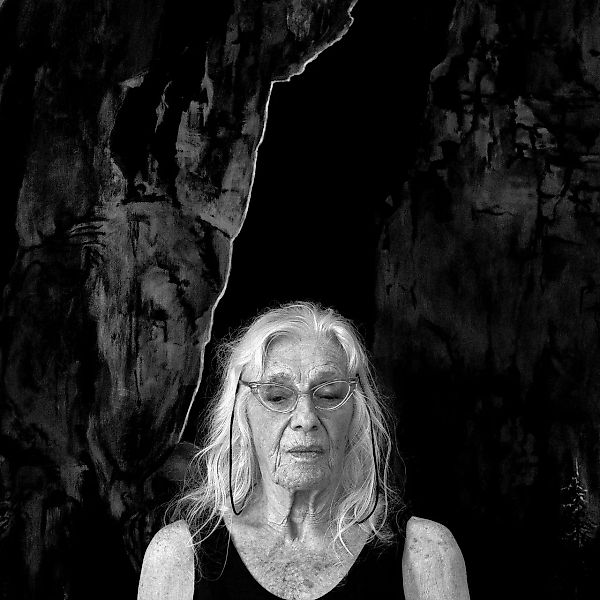
Painter Jo Baer, known for her fearless exploration of multiple genres, ranging from hard-edge Minimalism to what she called “radical figuration,” died on January 21 in Amsterdam at the age of ninety-five. Pace Gallery, which had represented her since 2019,announcedher death. First gaining renown in the 1960s and early ’70s for her color-rimmed black-and-white Minimalist works—no mean feat in a heavily male-dominated field—Baer in the decades that followed turned her attention to experimental and figurative painting before embracing digital collage, seemingly without regard for cash flow or critical acclaim as she sought instead to test the limits of what an artist could do in the span of a sixty-year career. A prolific and accomplished writer, Baer was known for her acerbic wit, often brought to bear in the defense of painting, which was constantly being declared dead by such laureled giants as Donald Judd and Dan Flavin. “Jo Baer can be provocative, but the effect is never for the sake of mere provocation,” wrote Lauren O’Neill-Butler in a 2021 issue ofArtforum.“Without fear or apology, the artist says what she thinks.”
“It’s the only way to be, if you’re female,” Baer told historian Judith Stein in 2003. “You don’t get anywhere otherwise.”
Jo Baer was born Josephine Kleinberg on August 7, 1929. Her mother was a commercial artist and an active feminist; her father was a commodities broker. Having studied art at the Cornish College of the Arts as a youth, Baer attended the University of Washington in Seattle with the intention of becoming a medical illustrator, as her mother hoped she would, before moving to New York, where she earned a graduate degree in psychology from the New School for Social Research while working as a draftsperson for an interior design studio. Following her 1953 graduation and a stint in LA, she returned to New York in 1960, where she began painting and drawing in earnest.
Working in a hard-edge Minimalist style and keeping in mind the concept of the Mach band, an optical illusion in which the human eye perceives a greater contrast, or a sharper edge, between shades of gray that touch one another, she began creating the canvases that would first (and soon) bring her to wide attention. These typically featured broad, square or rectangular expanses of white or gray, bordered by a heavy band of black, the two non-hues separated by a narrow strip of color. Representing an attempt to produce what Baer described as “poetic objects that would be discrete yet coherent, legible yet dense, subtle yet clear,” the works appeared to alter the spaces in which they were hung, thanks to the interplay between darkness and light, between color and noncolor. Her work appeared in watershed New York group shows including “Eleven Artists” at Kaymar Gallery, in 1964, and “10” at Dwan Gallery and “Systemic Painting” at the Solomon R. Guggenheim Museum, both in 1966. That same year she enjoyed her first solo exhibition, at Fischbach Gallery.
Following a 1975 midcareer survey of her work at the Whitney Museum of American Art, New York, Baer decamped for Europe, where she would remain for the rest of her life, settling permanently in Amsterdam in the early ’80s after bouncing around London and Ireland. “I didn’t like the pressures of New York,” she told Stein. “People want you to keep doing exactly what you’ve already done, because it makes money.” In 1983, seeking “more subject matter and more meaning” in her work, she authored a now-famous letter toArt in America, in which she announced her shift from abstraction to what she termed “radical figuration,” a genre she identified as blending abstraction and figuration to create forms that appeared fractured or otherwise altered in works that shunned narrative structure. This new genre, too, which incorporated mythological and historical themes, brought her accolades. In recent years, she began making digital collages, which she printed out and drew on; as well, she revisited old, lost works, remaking her early hard-edge abstractions from photographs.
Baer’s writings—including her letters toArtforum—are collected in the volumeBroadsides and Belles Lettres: Selected Writings and Interviews 1965–2010.Her work is held in the collections of major institutions around the world, among them the Los Angeles County Museum of Art; the Art Institute of Chicago; the Guggenheim Museum, New York; Tate Gallery, London; the Stedelijk Museum Amsterdam; the Louisiana Museum of Modern Art, Humlebæk, Denmark; and the Museum fur Moderne Kunst, Frankfurt. Her work is included in the group show “Vital Signs: Artists and the Body,” on view at the Museum of Modern Art, New York, through February 22.
Baer continued to work until the end of her life, her most recent solo outing being a 2023–24 exhibition at the Irish Museum of Modern Art in Dublin. “I’m curious,” she told the Brooklyn Rail in 2020. “Always.”