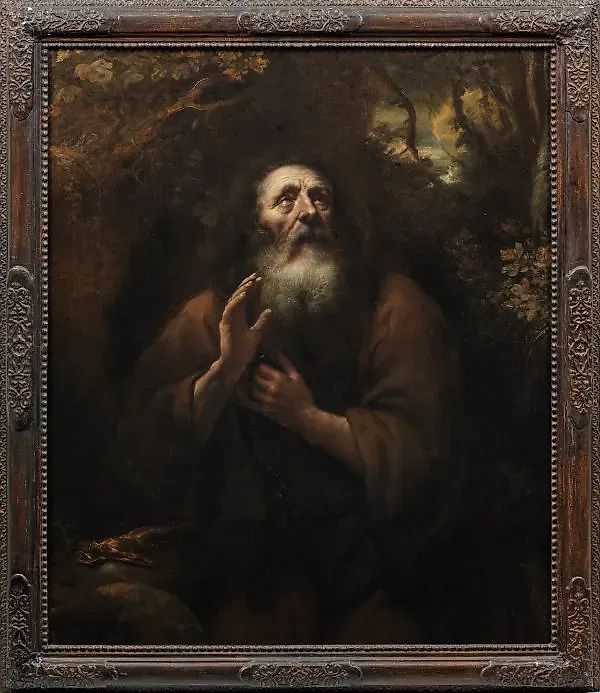
"Hermit in the Desert: Meditation of Art"
Description
(1623 Tönning – 1678 Friedrichstadt) Meditating Hermit in the Desert (Saint Jerome as a Penitent). The dating of 1660 on this painting, with its vivid chiaroscuro effects and expressive head of the figure, coincides with the period of Owens’s stay in Amsterdam (1657–1663). At the same time, it serves as a starting point for classification in Owens’s oeuvre, who played a significant role as an intermediary in the transmission of art between two cultural centers of contemporary Europe—the artistic capital Amsterdam and the Duchy of Schleswig-Holstein-Gottorf. Owens was a participant in the Dutch Golden Age, but also an outstanding figure during the heyday of Gottorf in the 17th century: from 1646 until his death, he was the most significant artist in the service of the Dukes of Gottorf. Thanks to his education and connections in the circle of Rembrandt, Govert Flinck, and the art dealer Hendrick van Uylenburgh, he received commissions from both the bourgeoisie and the nobility in the Netherlands and Schleswig-Holstein. Around 1640, Owens arrived in Amsterdam, where he was probably a pupil in Rembrandt’s workshop, but likely also studied under Govert Flinck. From 1651 to 1657, Owens lived in Schleswig-Holstein; from 1657 to 1663, he spent six years in Amsterdam, where he probably worked in Govert Flinck’s studio. In 1663, he returned to Friedrichstadt, where he remained based—except for short trips to Hamburg and Amsterdam—until his death. Owens mainly worked as a respected portraitist, but also as a painter of historical and allegorical scenes, as well as religious works. Stylistically, he shows the influence of Dutch and Flemish painting, less from Rembrandt than from Govert Flinck, Jan Lievens, Ferdinand Bol, and Anthony van Dyck. Oil on canvas; signature and date: “J. Owens / 1660 f”. 111 cm x 92.5 cm. Framed. Provenance: According to an old, barely legible inscription on the reverse, formerly in the collection of Gio(vanni) De Rossi (1754–1827); sold by him in 1802 to “Cardinal” Venuti; later in the collection of L. Churchill (?) and the Lüders (?) collection, Berlin, until 1905; Bukowski auction, Stockholm, 11–13 October 1950, lot 170; Bukowski auction, Stockholm, 5–7 December 2000, lot 390; Dorotheum Wien auction, 5 October 2005, lot 261; Sotheby’s auction, London, 10 July 2008, lot 209; Hans Gallery, Hamburg, 2011; since then in a German private collection. Literature/Exhibitions: Exhibition catalogue “Schleswig-Holstein Art of the 15th–19th Centuries,” Karl R. Reineer and Karl Lewinski, Berlin, 1909/10, p. 28; Harry Schmidt: “Jürgen Owens. His Life and His Works,” Kiel 1922, p. 183, No. 85; Catalogue “Rembrandt’s Teacher – Sumsowski’s Teacher,” Kunstverein Aalen, 2019, pp. 70–73, 123–124, No. 17 (with illustration on p. 71). Documented in the Royal Institute for Art History Studies in The Hague under illustration number 0000180779. Oil on canvas. Signature and date lower left: “J. Owens / 1660 f”.
Similar lots
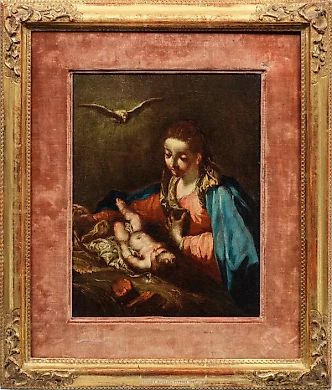
Lot No. 14785 The Nativity of Christ in Venice
Giovanni Battista Pittoni

Lot No. 14784 "The Supper at Emmaus" - a dramatic scene of Ch…
Josef Bergler the Younger
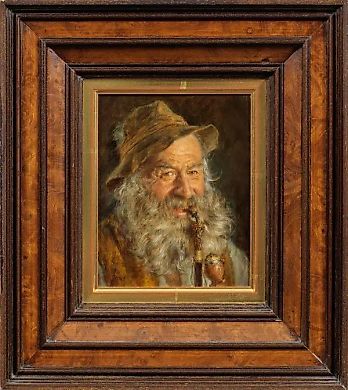
Lot No. 14087 Portrait of an Upper Bavarian Gourmet with a Pi…
Hrvoje Melkus
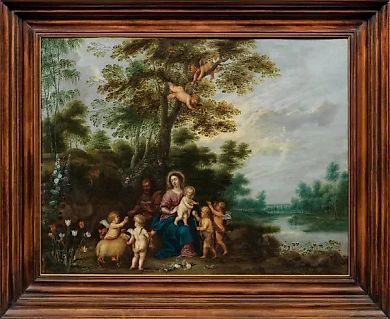
Lot No. 14807 "The Holy Family with the Infant John: workshop…
Jan Brueghel the Younger
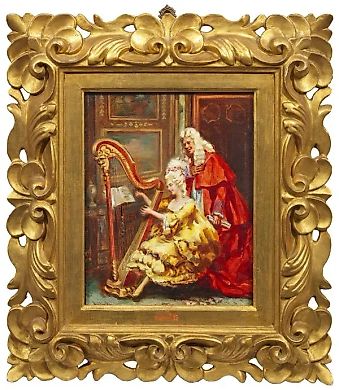
Lot No. 14695 "The Harpist in a Palace Interior: a young lady…
Sinigbaldo Tordi
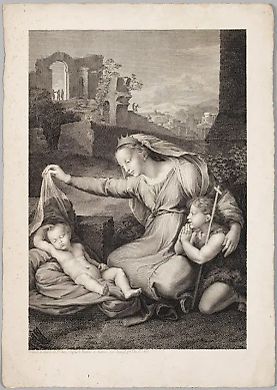
Lot No. 14039 "Copper engraving by Filippo Scheri, 1805, afte…
Philippe Shere
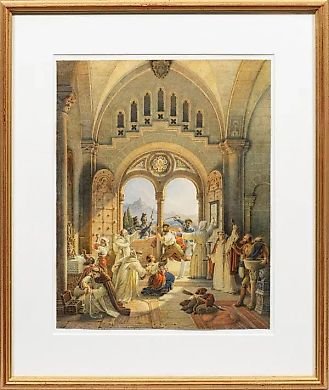
Lot No. 14166 Italian Architect in Dresden: Rare Watercolor w…
Maximilian Albert Gaushild
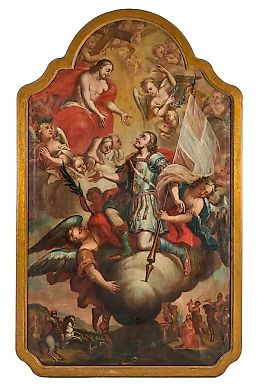
Lot No. 14783 The majestic altarpiece with Saint George: the …
Unknown Author
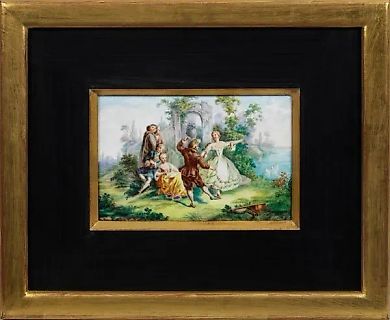
Lot No. 14321 Porcelain tile depicting a "Fête champêtre" sce…
Meissen (Meissen)
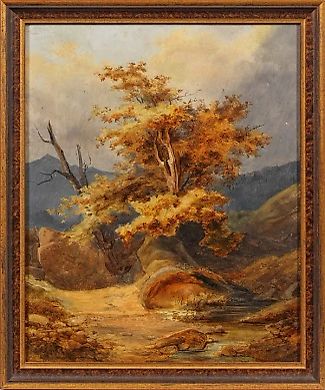
Lot No. 14772 "An old tree in autumn shades: a mountain lands…
August Wilhelm Ferdinand Schirmer