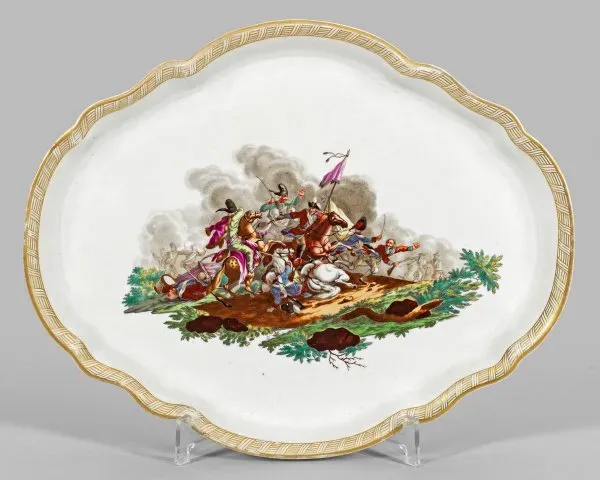
The Ludwigsburg Porcelain Manufactory (German: Die Porzellan-Manufaktur Ludwigsburg) was one of the significant Western European porcelain factories of the 18th century, located in the city of Ludwigsburg in the state of Baden-Württemberg, southwest Germany. The most well-known marks of the manufactory include two intertwined letters "C" in blue underglaze, one of which is upside down, sometimes with a ducal crown (1758-1793), the letter "L" under a crown (1793-1795), "FR" under a crown (Fridericus Rex, 1806-1810), "WR" in gold (Wilhelmus Rex, 1816-1824), or the "Deer Antlers" from the coat of arms of Württemberg with the letter "C". History: As early as 1729, Elias Fater, a mirror and glassware manufacturer, proposed the idea of his own porcelain factory to Duke Eberhard Ludwig, but the idea was deemed unnecessary at the time. Only in 1756 was a small factory established in Ludwigsburg, and on April 5, 1758, by order of Duke Carl Eugen von Württemberg, it was transformed into a ducal institution known as the Herzoglich-Acht Porcelaine-Fabrique and operated on the grounds of the Ludwigsburg Palace. After the dissolution of the Holy Roman Empire in 1806, the Duchy of Württemberg became a kingdom, and the official name of the factory changed to the "Ducal-Royal Porcelain Manufactory Ludwigsburg" (Herzoglich-Königliche Porzellan-Manufaktur Ludwigsburg). By 1913, the workforce of the manufactory consisted of two hundred people. After the first two successful decades of operation, mainly in artistic but not financial terms, production gradually declined. The Duke's death in 1793 undermined the position of the manufactory. Production was closed in 1824. The manufactory, which was renamed "Palace Manufactory Ludwigsburg" (Schlossmanufaktur Ludwigsburg GmbH) in February 1919, later became "Porzellan-Manufaktur Alt-Ludwigsburg GmbH" and then "Württembergische Porzellanmanufaktur". After many difficulties, it was recreated in 1948, but in a more limited capacity.In 2008, it went bankrupt and was finally liquidated due to financial circumstances in 2015. Artistic Features of Ludwigsburg Porcelain
Duke Eugene invited experienced master craftsmen and artists to work. A year after its foundation, he invited Joseph Jacob Ringler (1730–1804) from Vienna to serve as the director, who, in addition to working at the Vienna Manufactory, had experience in organizing similar productions in Höchst, Fürstenberg, Nymphenburg, Neudek, Strasbourg, and Württemberg. Ringler had thirty-five employees at his disposal. He worked as director until 1802. His son, Philipp Joseph Ringler, worked as a painter at the manufactory starting in 1775.
The sculptor-modelers of the manufactory were Jean Louis, P. F. Lejoune, and Johann Wilhelm Beyer (1725–1796), a German painter and sculptor. Beyer worked in Ludwigsburg from 1759 to 1767. During his educational trips to Rome, he became acquainted with classical art and became one of the first admirers of classicism in Germany. In addition to various figurines in folk costumes, peasants, merchants, and musicians, he created allegorical groups of figures on the themes of ancient history and mythology.
The sculptor-modeler Johann Goetz and the duke himself, the patron of the manufactory, were fans of music and ballet. This explains the abundance of sculptural figurines depicting musicians, famous dancers, characters from court ballet performances, and Italian Commedia dell'arte theater productions.