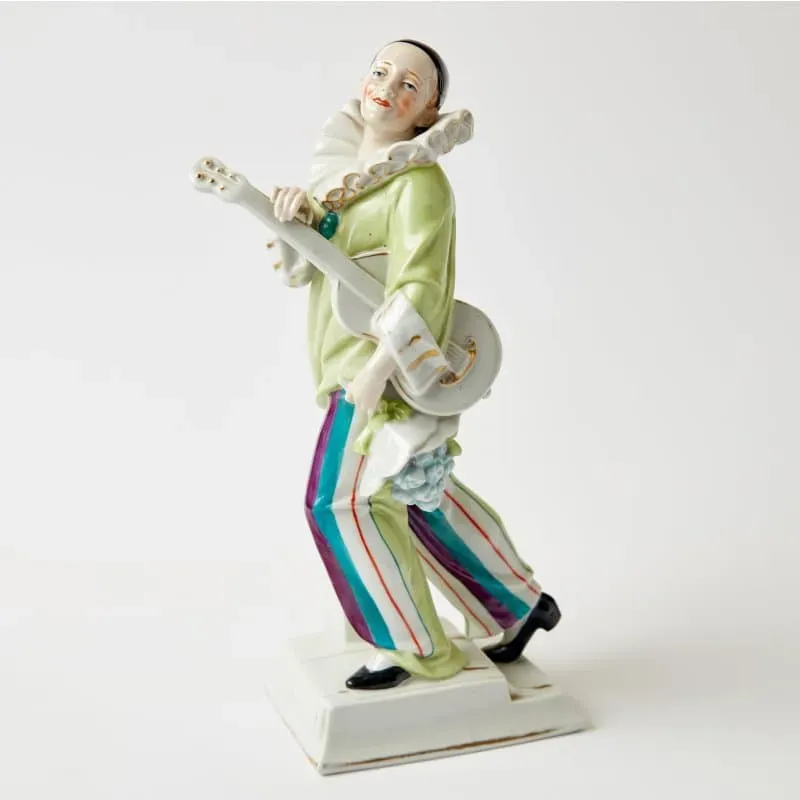
Porcelain, earthenware, ceramics
Katzhutte ( Hertwig & Co )
Health problems forced Ernst to leave the company, and soon his father Christoph was also forced to retire. Two other sons, Karl and Friedrich, took over the management. Due to the high demand for dolls and decorative elements produced by the Hertwig company in the American market, the firm prospered. Despite having many competitors in the doll production industry in Germany, Hertwig continued to produce high-quality products at fair prices, while providing good working conditions for their employees.
The third generation of Hertwigs, Fritz, Ernst, and Hans, took over the business in 1915. In 1937, partial automation of production occurred, leading to changes in the product range.
The company survived the Second World War without damage, but after the war, it mainly produced utility ceramics and decorative porcelain. After the war, the company found itself in the Eastern occupation zone, in East Germany (GDR). However, in 1951, it once again made a name for itself as a producer of "small Bisculoid dolls in the traditional old style". But now, trade representatives in the Western zone could only order these toys through an intermediary supplier in Nuremberg. In 1953, advertisements for new plastic dolls from the Hertwig company with a clover leaf marking appeared in West Germany. These highly popular plastic dolls can still be found in many doll collection houses. They were affordable and durable, so today they are as common as the rubber dolls from the GDR. The production of these dolls was located in the city of Worms.
In addition, Hertwig also produced flexible dolls called "Biegepuppen" in the 1950s. Biegepuppen from this period are rare, and even finding photos of them is not easy. Svente Keller, a well-known author, was known for his book about Hertwig dolls.The text talks about dolls and articles about dolls. It states that the Hertwig company from Thuringia and the new Hertwig company from Worms in West Germany are two completely different companies. However, the "Spielzeug" magazine emphasized the unity of the West German company with the traditions of the well-known old company from the eastern part of Germany in 1962. From the "Spielzeug" magazine: "Small plastic dolls, ranging in size from 5 to 11 cm, naked or dressed, among them also flexible dolls. The dolls are made by the Hans Hertwig company, which has a nearly 100-year history as the famous porcelain factory Hertwig & Co. in Katzhütte, Thuringia, and which established a new production location in Worms in 1953." Marci and Bob Tubbs also believe that it is obvious that a family member named Hans established a new enterprise in the West, using the well-known name and know-how. Marci and Bob Tubbs wrote a remarkable chapter in their book "Dollhouse and Miniature Dolls" about the company, where they report that the grandchildren of the Hertwig family managed the company until it was expropriated by the GDR government in 1958. From that time on, the factory was called VEB Zierkeramik, and the assortment was significantly reduced to decorative ceramics, but the factory continued to operate until 1990. It is a very interesting fact that during the nationalization of the historical archive, which was stored in containers and contained demonstration materials and technical information, it was completely forgotten. In addition to documents, a lot of historical samples of the factory were archived. Dolls, vases, and figurines were packed into boxes and stored in one of the warehouses. This archive was completely looted by state companies in the early 1980s, and most of the items were sold at auctions in Berlin and London. Thanks to this fact, porcelain items produced at the factory before 1958 are highly valued among experts and collectors. Some of these dolls were placed in the toy museum in Sonneberg several years prior to this, and many were taken and hidden by the Hertwig family until 1953.After the fall of the Berlin Wall, which began in 1989, international law required that the Hertwig company's items in the Sonneberg museum be returned to the family. So why is the Hertwig company so important in the world of dolls? Because in every collection of antique dolls in the world, there is at least one, if not several, specimens made by this company. This is a very bold statement, but due to the wide variety of products produced, the huge volume, and the fact that the company remained in business for almost 100 years, we all must have something created by a company that seemed to know exactly what its customers wanted. From a business perspective, the Hertwig company saved the village. The family provided employment, fair wages, improved living conditions, and expanded socialization in a remote area for generations.