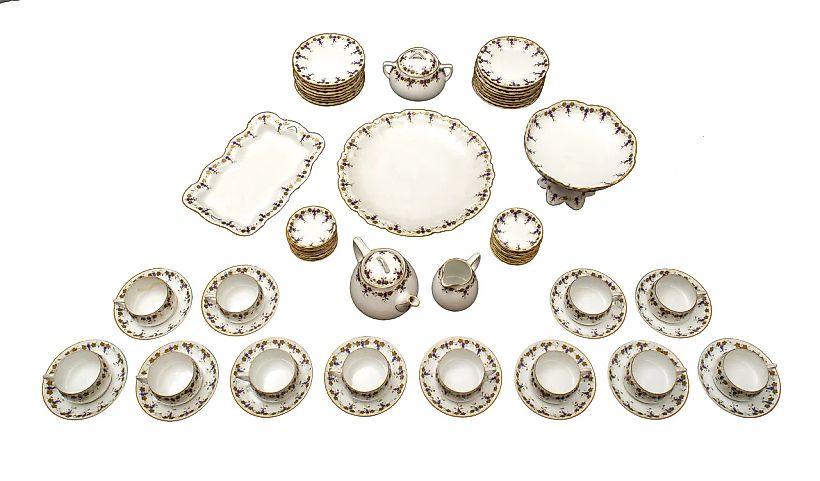
Antique Imperial Russian porcelain tea service from the Gardner Kuznetsov factory
Description
Antique Imperial Russian porcelain tea service from the Gardner Kuznetsov factory. Antique Imperial Russian porcelain tea service from the Gardner Kuznetsov factory. Circa 1870-1890 according to the marking. Dimensions, height/diameter: 12 cups, 50x80 mm; 12 saucers, 20x142 mm; 1 teapot, 150x115 mm; 1 sugar bowl, 100x150 mm; 1 milk jug, 110x170 mm; 1 tray, 40x325 mm; 1 cake stand, 155x215 mm; 1 shaped tray, 295x185 mm; 18 butter dishes, 20x94 mm; 18 small plates, 250x163 mm. Restoration on one cup and a crack on one cup, otherwise very good condition. Russian porcelain tea service for twelve people, with an elegant pattern of purple and gold grape leaves. Well marked on the bottom in red underglaze paint by the Gardner firm. The service includes twelve cups with saucers, a teapot, a sugar bowl with lid, a milk jug, a cake stand, a rectangular tray, eighteen butter dishes, and eighteen small plates. Founded in Verbilki (Moscow region) by the Englishman Francis Gardner in 1766 and known for its porcelain goods, the Gardner factory was an important competitor to the Imperial Porcelain Factory, encouraging artists from both factories to produce more complex pieces in both form and decoration. There were two porcelain factories in Russia in the 18th century. The factory was particularly advantageously located in the Gzhel area, where local clay material suitable for porcelain production could be used. Gardner started with his German manager named Gattenberg, who later moved to the Imperial Factory, and hired the famous German artist Kestner. But these and other foreigners trained many Russian craftsmen, mainly serfs, who gradually replaced them once they mastered the various techniques, so the number of foreigners holding key positions gradually decreased over time. The factory was a family-run operation for three generations until it was taken over by Kuznetsov in 1891. Gardner porcelain had a great variety of marks over its 140-year existence. Various forms of the Latin letter G, painted in underglaze blue or black, were the most common in the late 18th and early 19th centuries. Sometimes the mark resembles the Meissen crossed swords mark with a star. In the first quarter of the 19th century, the full name of the factory, printed on the factory mark either in Cyrillic or Latin, is more frequently encountered. In the second half of the 19th century, the mark is usually represented by the Moscow coat of arms of St. George and the dragon, surrounded by a circle, with the full name of the factory, first printed and later painted in green or red. In the final decades of the factory's existence, a double-headed eagle was added to the mark, and this complex mark continued even after the Gardner firm was absorbed by the Kuznetsovs. For inquiries, detailed condition reports, and additional images, please write to [email address]. From a private collection from Italy.
Similar lots
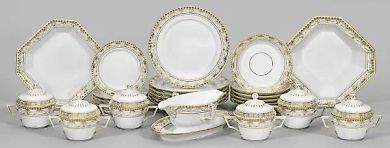
Lot No. 14198 Set "Courland" with gold
KPM (Knallegårdens E.B. Design)

Lot No. 13105 Set of four French glass and gilt metal wall sc…
Lighting fixtures
★★★
Lot No. 13149 Silver casket
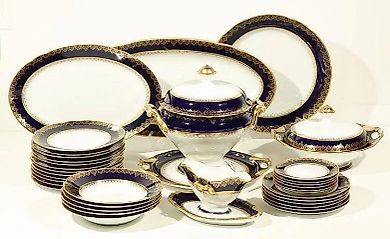
Lot No. 15888 Porcelain set from the Kuznetsov factory, circa…
Kuznetsova M.S. society
Lot No. 206 1920s Silver buttons, 9 pieces!
Lot No. 14498 Elegant tray
Viner (Viners)
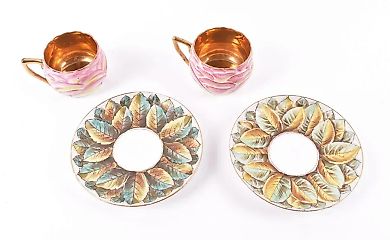
Lot No. 15185 Imperial Kuznetsov porcelain cups and saucers i…
Kuznetsova M.S. society
Lot No. 14483 A mixed set of seven English sterling silver sa…

Lot No. 14193 Six vases.
KPM (Knallegårdens E.B. Design)

Lot No. 14367 A collection of five porcelain plates with frui…
Meissen (Meissen)