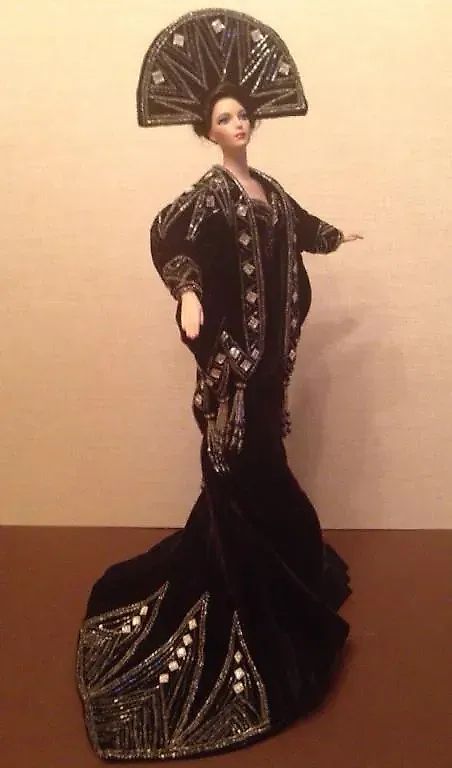
Porcelain Russian Princess
Description
Roman Petrovich Tyrtov (pseud. Erté; November 23 [December 4], 1892, St. Petersburg — April 21, 1990). Porcelain Russian Princess.
Author's work by Erté - "Stardust". Porcelain. Fabric. Stones. Collectible condition. Certificates.
Branded box designed by Erté. On the box, a price tag from twenty years ago - $750 USD. Dimensions: 45 cm x 25 cm x 20 cm.
Fashion designer, graphic artist, set designer. Representative of an ancient lineage tracing back to the Tatar Khan Tyrt. Son of Pyotr Ivanovich Tyrtov, a hereditary naval officer and head of the Naval Engineering School. In 1900, he visited the World's Fair in Paris with his mother and sister. He was introduced to I. E. Repin and received his first painting lesson from him. In 1910, he studied with the artist D. E. Losevsky. In 1912, after finishing high school, he rejected the traditional military career of his family and, with his father's permission, left Russia. (In 1923, with the help of the Red Cross and the American Relief Administration, he evacuated his parents from the USSR.) Settling in Paris, he became a correspondent for the St. Petersburg magazine "Damskie Mody" (Ladies' Fashions). He briefly attended the Académie Julian (class of historical painting by J.-P. Laurens), then studied independently. He adopted the pseudonym "Erté" (from the initials of his first and last names) to avoid "disgracing" his family. In 1913, he began working for couturier Paul Poiret alongside artists Georges Zimora and Paul Iribe. He created his first works for the stage, including costumes for Mata Hari's performance "Minaret" at the Théâtre de la Renaissance. With the outbreak of World War I, he moved to Monte Carlo. In 1915, he signed a long-term contract with the American magazine "Harper's Bazaar," for which he designed over a hundred covers over the next 22 years. He also drew for the American magazines "Vogue," "Cosmopolitan," "Women's Home Journal," "Delineator," the British "The Sketch," "Illustrated London News," and the Parisian "Femina," "La Gazette du Bon Ton," and "Plaisir de France." From 1917 to 1927, he designed shows and created costumes for the Folies Bergère music hall. In 1922, he received an offer from S. P. Diaghilev to design Tchaikovsky's "The Sleeping Beauty" but declined due to a more lucrative contract in the USA. From 1925, he worked under contract with the Hollywood studio Metro Goldwyn Mayer and collaborated with silent film stars Lillian Gish and Mae Murray. He created set and costume designs for Broadway music halls and the Chicago Opera. He designed costumes for ballet numbers by Anna Pavlova.
In 1927, he designed numbers for Josephine Baker at the Parisian music hall "Ba-Ta-Clan." In 1933, he began a long-term collaboration with the Parisian variety show "Bal Tabarin." In the 1920s–1930s, he developed fabric patterns, created models of outerwear, shoes, and accessories in the Art Deco style; he collaborated with leading American fashion salons. From 1929, he emerged as a reformer of men's fashion, advocating for men's right to wear brocade and velvet following 18th-century models. He held his first solo exhibitions in Brussels (Studio Gallery, 1927) and Paris (Hôtel J. Charpentier, 1929). During World War II, he remained in Paris. He created sets and costumes for shows at the Lido cabaret and operettas. In the 1940s–1950s, he continued working in set design: designing productions for the Parisian variety show "La Nouvelle Ève," and collaborating with theaters in Paris, Chicago, New York, London, Marseille, Rome, Barcelona, Madrid, and Beirut. He worked on sketches of accessories and jewelry for fashion magazines. In 1964, he turned to sculpture, creating abstract (in his words, "pictorial") forms. He worked in watercolor, gouache, and ink, engaged in lithography, and created posters, sketches of vases, furniture, mirrors, and other luxury items. He produced the graphic series "Numbers" and "Alphabet," and designed playing cards. He continued collaborating with fashion magazines and working in theater.
He designed productions by Roland Petit featuring Renée Jeanmaire (Zizi). He developed the "unisex" style – matching costumes for men and women. In 1964, he held a solo exhibition at the Galerie Ror Volmar in Paris; in 1967–1968, exhibitions at the Grosvenor Gallery in London and the Metropolitan Museum of Art in New York (all 170 pieces were acquired by the museum); from 1969 to 1973, a series of solo exhibitions in Paris, Chicago, New York, Mexico City, Parma, Palermo, and Milan. During these years, his popularity grew due to a renewed interest in Art Deco. Based on his sketches, limited-edition decorative and applied arts pieces were created, and lithographs and postcards were published. He wrote a memoir (published in 1975 in New York and London). At the age of 97, he completed his final work – sketches of sets and costumes, and a poster for the Broadway musical "Stardust." He died at the Cochin Hospital in Paris after a brief illness that began during a trip to Mauritius. He was buried in the family grave at the Boulogne Cemetery near Paris.
Similar lots
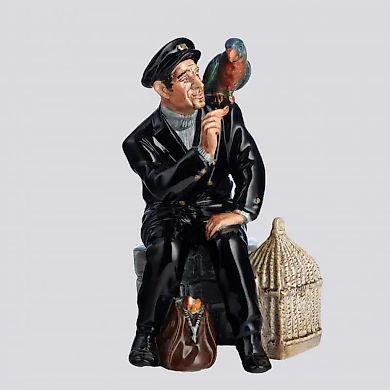
Lot No. 13668 Vacation by the shore
Royal Doulton (Royal Doulton)

Lot No. 13661 Statue of Robert Burns
Royal Doulton (Royal Doulton)
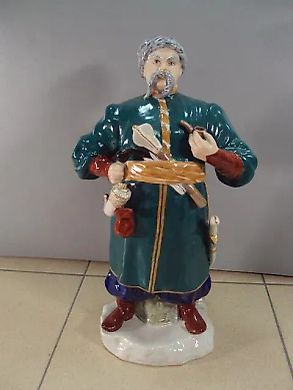
Lot No. 12817 Cossack Taras Bulba
Baranovsky Porcelain Factory
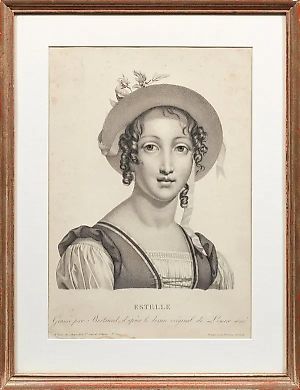
Lot No. 14038 "Fluorography on Paper: An Original Title by Ch…
Frances Bertrand
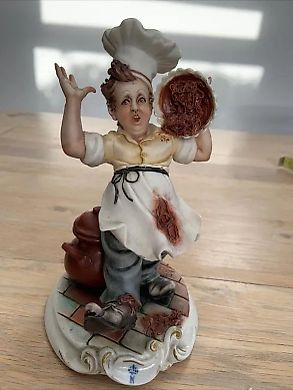
Lot No. 12729 The cook who spilled the spaghetti
Capodimonte